Interview with a Writer ~ Judith Vallely

Happy New writing year! I’m delighted to kick off 2026 with an interview with writer and journalist, Judith Vallely. After featuring Judith’s writer mum, Myra Duffy, on my blog back in November (see here), it’s a pleasure to now find out more about Judith’s writing career.

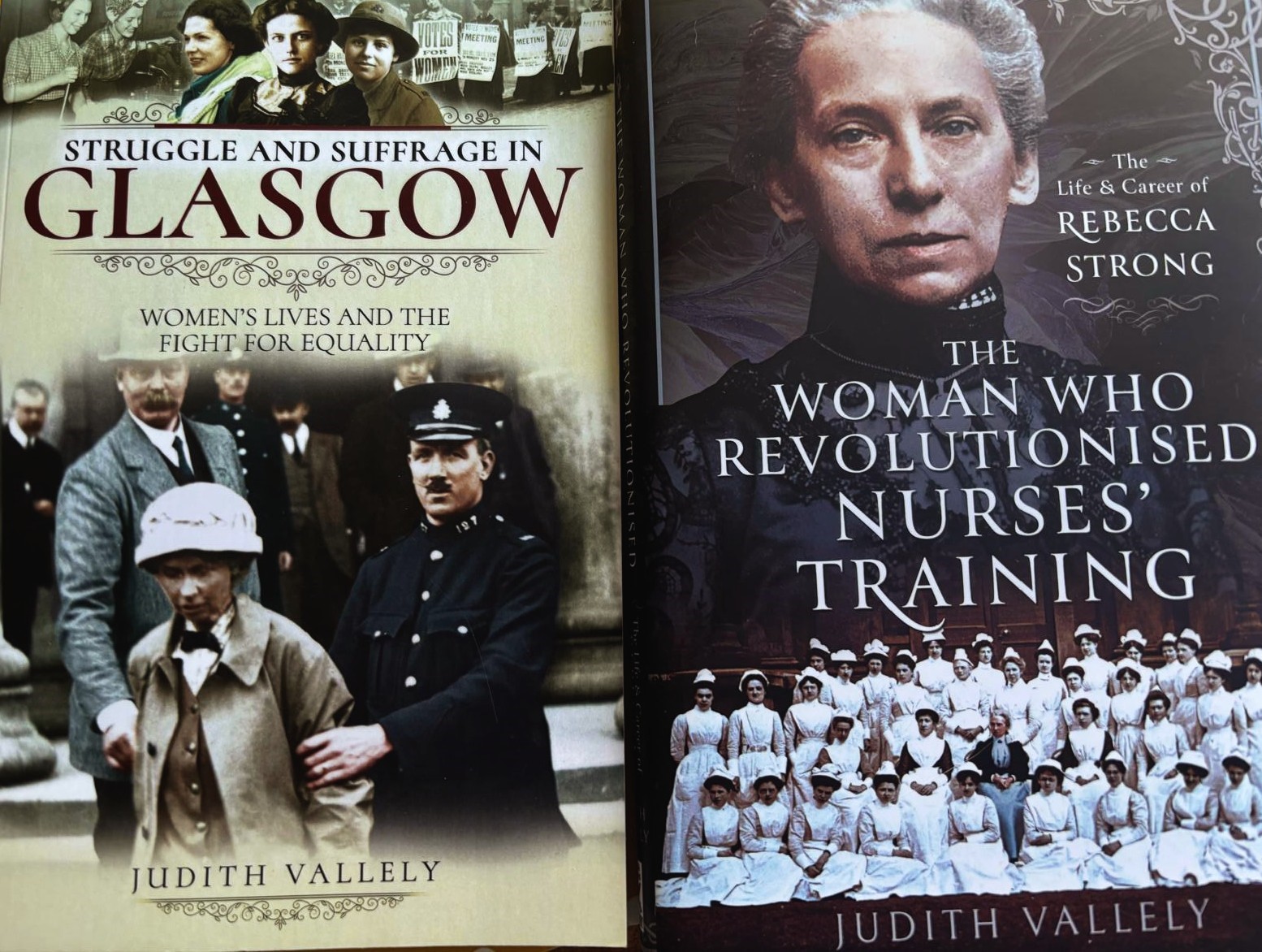
It was interesting to gain insights into Judith’s extensive journalism career, and find out more about how she has managed to balance a busy day job alongside researching and writing fascinating non-fiction books (see photos above of these books, and links below of where to buy).

I have a lot of admiration for writers who manage to multi-task, as it’s something I often struggle with; knowing how to give priority to everything I want to achieve. There’s some great tips here from Judith to keep us all motivated. If you’ve made some writing resolutions of your own this year, I wanted to extract one simple reminder from Judith: ‘If you are struggling to write, just start with a sentence…’ Read on to find out more…

Writer Biography

Judith Vallely is a writer and journalist who lives and works in Glasgow and has an MA in English and Scottish Literature from Edinburgh University, and a postgraduate diploma in newspaper journalism from Napier University, Edinburgh. 

She is the author of Struggle and Suffrage in Glasgow: Women’s Lives and the Fight for Equality and The Woman Who Revolutionised Nurses’ Training: The Life and Career of Rebecca Strong

When did you first start writing?

I’ve always loved reading and writing from a young age – scribbling down various stories. I’m told when I was around five years old I used to sneak out of bed late at night and be discovered looking at books.

What do you write?

I’ve had a 20 plus years career in journalism writing mainly news stories, but also features and travel writing. I’ve also had two non-fiction books published  and am working on improving my fiction writing skills, hopefully with a view to publication one day. 

What was your first published piece of work?

When I was 16 I did a week of work experience at the Evening Times and had a letter published about the dangers of ‘devil dogs’. It was the letter of the day, but I never did get the cash for it!

Why do you write?

Very good question! There’s various answers – I really enjoy discovering and telling stories about people and places. Sometimes I have an idea in my head which I want to get down. Sometimes it’s just because I have a deadline looming! Overall I find writing a really absorbing activity and love words — that thing known as flow, when you get totally immersed.

What, or who, has helped you on your writing journey?

Too many to mention! Journalism has been the biggest part of my writing career and I feel lucky to have started out at a time when it was normal for stories to go through an extensive editing process before being published. In the digital age, it now seems like a long ago luxury to have several editors looking at your work and (usually!) making it better.

And shout-out to my mum (myraduffywriter.com), who has always been very encouraging and a hard act to follow with her many published books! 

Share a writing low with us. What did you learn from this?

I think anyone who has written a book has experienced that moment of thinking it’s just complete rubbish and having the urge to chuck it in the bin forever. However I’ve realised it’s part of the process and that urge must usually be resisted. 

Share a writing high?

My very first story as a journalist was published on the now long defunct Ceefax service. It didn’t have a byline and was just four paragraphs long, as was the format, but it was amazing seeing what I had written out there in the big wide world.

Share some of your favourite lines from reviews, or comments you have received about your work, which boosted your confidence (tell us what piece of work it relates to)

Writing my second book on the life of Rebecca Strong was a real labour of love – I took on the project when I was working freelance but then moved into a very busy full-time job, so it required a lot of dedication (writing and editing by the pool while on holiday in Lanzarote) and the horror of pushing back deadlines (very difficult as a trained journalist) to see it to the end. By the time the book was published I could hardly bear to look at it.

So I was really pleased to get some lovely comments in reviews which made it worthwhile including one which said: “What a great read into the history of what was and how it was shaped into what we now have. Thank you for bringing this information to light, and highlighting the hard work that was put into what we now take for granted”.

Any tips for new writers? 

If you are struggling to write, just start with a sentence – it doesn’t matter how bad or good it is, get something down on the page and then take it from there. There’s nothing worse than a blank page staring at you.

And leave as much time as practical between writing and reviewing your writing – at least overnight. This isn’t always possible, especially in journalism, but I think it is hugely helpful to have fresh eyes on it – and that also should include other people where possible. 

And for all writers; any tips for keeping motivated? And how do you find time to write?

I think the answer ultimately is just to sit down and write – which is easier said than done. An external or self-imposed deadline (such as a competition entry) helps me enormously, as a result of years of journalism.  I am terrible for thinking I’ll write more when…My current ‘when’ is when I have a writing shed but having read Brian Bilston’s very funny ‘Diary of a Somebody’ I realise a/ I am not alone in this and b/ it won’t necessarily help my productivity. 

Do you have a regular writing routine, or do you write in frantic bursts? Where do you write? (A dedicated space, or on-the-go)

I would love to be a writer who gets up at 6am and spends a couple of hours crafting beautiful sentences before the day begins. In reality, I’m not a morning person and can barely string two words together without lots of coffee.  I write wherever and whenever the mood takes me, unless I am working on a book in which case I usually set dedicated time in a little work study at home. 

Any stand-out books you have read recently?

I recently read Elif Shafak’s The Island of Missing Trees for a book group and totally loved it. She writes the beautiful sentences which I aspire to. She probably begins early in the morning, I imagine. 

Where can we find out more about you, and your books?

You can buy Judith’s books here:

Publisher (Pen and Sword), website here

Amazon links: The Woman Who Revolutionised Nurses’ Training: The Life and Career of Rebecca Strong https://amzn.eu/d/h8zibOp

Struggle and Suffrage in Glasgow: Women’s Lives and the Fight for Equality https://amzn.eu/d/6sntOqf

You can find Judith on Twitter X @JudithVallely and Instagram @vallelyjudith

Interview with a Writer ~ Rachel Sargeant

After months of blogging about own my writing journey I thought it would be interesting to gain an insight from other writers about their paths to publication, inviting them to take part in an ‘Interview with a Writer’ feature. Today, I’m delighted to welcome prolific and talented writer Rachel Sargeant to my blog and I hope you enjoy reading about her journey as much as I did. Rachel has been a supportive online writing friend and reading her answers below really cements the importance of surrounding yourself with an encouraging community.

Read on to find out more about Rachel and her fabulous books (I’m reading The Roommates just now and it’s a page-turner!).

Rachel Sargeant is the author of The Perfect NeighboursThe Good TeacherThe RoommatesHer Deadly Friend; and Her Charming Man. After many years in Germany, she now lives in Gloucestershire. Her hobbies are visiting country houses and coffeeshops, watching amateur theatre and travelling with her husband to visit their grown-up children in various places around the world. She also likes chatting about books with readers and writers on her blog.

Thank you, Victoria, for inviting me to take part in an interview. I look forward to reading your interviews with the other authors taking part.

When did you first start writing?

Writing was my favourite activity at primary school. In my own time at home, I wrote a comedy sketch, a musical and… a bodice-ripper. I think the idea for that came from a story I read in a magazine in the dentist’s waiting room. When I got to secondary school, homework took up time, so I forgot about writing.

Years later, I moved to Germany and became a mum. On a rare night out, I went to a summer ball. A palm reader was present as part of the entertainment. She read my palm and was insistent I should write, so I did. That was 26 years ago, and I haven’t stopped since.

What do you write?

Crime, suspense and psychological thrillers

What was your first published piece of work?

A few months after the palm reader in Germany told me to write, I went to a writing workshop in Shrewsbury. The tutor was crime writer David Armstrong, the father of a (at the time) young, hopeful screenwriter by the name of Jesse Armstong, much later of Succession fame. David set a five-minute exercise about a crime scene. Feedback from him and the other students on my effort was really encouraging.

On the way home I bought a copy of Writing Magazine and saw an advert for their Crime Short Story competition. Buoyed up by the positive comments from the workshop, I expanded my hundred-word exercise into a sixteen-hundred-word story and, in a stroke of beginner’s luck, won the competition. That story became my first published piece of work when it appeared in the magazine’s competition supplement.

Why do you write?

I love getting ideas for plots, characters and settings from my head onto a piece of paper. I don’t really know why, but I feel as enthusiastic about writing now as I did as the eleven-year-old producing risqué historical fiction.

What, or who, has helped you on your writing journey?

My husband provides the means and opportunity for me to write and is my biggest cheerleader. As a press officer by profession, he comes up with innovative ways to promote my books.

Lots of other people have helped and continue to help. The greatest influence on my writing has been the students I met on my distance learning Creative Writing MA in 2013. When we were allocated to syndicates to exchange work, the four students in my syndicate transformed my writing life. They gave constructive but encouraging feedback, and I read their submissions in genres and styles I hadn’t encountered before.

Ten years on from the end of the course, I still exchange work with three of them. They’ve read the early drafts of all my novels and my PhD thesis. They are Fergus Smith, Peter Garrett and Jessie Payne, all excellent writers.

Share a writing low with us.

I worked on my MA portfolio for two years, but six weeks before it was due to be handed in, my tutor told me to rewrite it.

What did you learn from this?

What kept me going was the balanced perspective and support of my syndicate. They read vast sections of the re-write. The fourth member of the syndicate, Jenny, said to me. “I admire your resilience.” I’d never thought of myself as resilient, but at that moment realised I was. I keep that in mind whenever I have a writing setback.

The experience also taught me flexibility. There is a need to frame writing for specific audiences. I was tasked with rewriting my project to give it its best chance in front of the MA examiners. After the course, with more feedback from my writing buddies, I rewrote the portfolio again as a commercial thriller and secured an agent. The book was published by HarperCollins and became a bestseller.

Share a writing high?

I’m enjoying a writing high at the moment. The novel I spent four years writing as part of my PhD has found a home. The publisher, Hera Books, made the announcement this week. An Ordinary House will be published in 2026 under my new penname Rae Starling. Readers and authors have been leaving comments to congratulate me. It’s lovely to feel part of the book world.

Share some of your favourite lines from reviews, or comments you have received about your work, which boosted your confidence (tell us what piece of work it relates to)

I was touched when the late Nicki Richards, a lovely blogger and sadly missed, named The Roommates as one of her favourite reads of 2019.

I’ve been overwhelmed by the kind comments about my Gloucestershire Crime Series from readers I’ve met in person. I sometimes do book signings close to my home in Gloucestershire. Although I’ve lived here 15 years, I’m not from the county and I’ve taken liberties with Gloucestershire landmarks, renaming some, moving others around and completely inventing a few. I’m always nervous how my authorial reshuffle will go down with local people, but they’ve told me they enjoy working out what places inspired the settings.

Any tips for new writers?

Read, read, read and write, write, write.

The best way to get a feel for a genre is to immerse yourself in reading recent titles in that genre. You’ll absorb the rhythm, tone, characterisation, structure and descriptive style.  

And keep having a go yourself. In my experience, first drafts are hard; editing is easier, but you can’t edit a blank page.

And for all writers; any tips for keeping motivated?

Join writers’ groups. Perhaps take a formal course and meet fellow writing students. Engage with writers and readers on social media. Review other people’s books. Big up their new publications. Being part of a lovely tribe is a great way to feel motivated.

And how do you find time to write?

I’ve been writing full-time since October 2018. Before that, I wrote in the evenings after work. Before that I snatched an hour when my children were at after-school clubs.

Do you have a regular writing routine, or do you write in frantic bursts?

I usually deal with social media and read emails before I get out of bed, then sit at my desk from 9.30am. Apart from stopping to go to the shop or deal with chores, I’ll work through until 6pm. If I have a deadline, I might work in the evening too. I usually take weekends off.

Where do you write? (A dedicated space, or on-the-go)

A spare bedroom is my study. If the weather’s nice, I write or edit in the garden. Sometimes I’ll take a change of scene with a coffeeshop visit or simply sit in a different room in the house.

Any stand-out books you have read recently?

My standout read of the year so far is Her Many Faces by Nicci Cloke – clever angle, clever plot.

Other humdingers include:

The Crime Writer by Diane Jeffrey

Coram House by Bailey Seybolt

The Surfacing by Claire Ackroyd

Unknown by Heather Critchlow

I could go on. My Best Books of the Year post in December is going to be long.

Where can we find your books and find out more about you?

Link to buy Rachel’s books: https://t.co/89T86a9pon

Website: https://www.rachelsargeant.co.uk/

Twitter: @RachelSargeant3

Facebook: https://www.facebook.com/rachelsargeantauthor/

Bluesky: @drrachelsargeant.bsky.social

Instagram: https://www.instagram.com/rachelsargeant3/

Threads: rachelsargeant3

BookBub: @rachelsargeant3

Showing up (final post in series- blog post 15)

Back in January I decided to write a series of posts on here which focused on what my writing life has been like over the years. I wanted to share specific aspects that I thought might be helpful for writers just starting out, and also for seasoned writers who maybe just needed a reminder that we all experience very similar highs and lows, and to offer some encouragement to keep going during times you question your sanity, or ask yourself if it’s all worth it.

Over the past couple of months I’ve found it particularly difficult to focus on my writing. I’ve been struggling with tiredness and brain fog, a combination which isn’t great when you’re trying to plot and write a new book. But I’ve been determined to keep getting words down on paper/screen, and keep telling myself the first draft does not need to be perfect.

Embarking on a new book has reminded me of two important things:

It’s important to keep showing up

Each book takes shape in a different way

For my new project I’m trying to get words down not every day, but every week. That’s a win for me just now, and keeps the momentum going. Even although I was knackered yesterday I made myself sit down at my laptop and continue with my next chapter. I’m also doing my usual; scribbling notes in various notebooks and on the notes page on my phone. These pages are filled with plot ideas, characters and locations, that don’t yet have a place on the page, but I know they might eventually fit in somewhere, and it keeps the story ‘alive’ in my head. For me this is all part of the process.

I’d say so far my ‘work in progress’ is a bit messier than usual and as the book will require a lot of detailed description (to world build), I’m finding this is slowing down my natural writing style (which is usually a bit more dialogue heavy). I’m allowing myself to skirt over parts of the descriptions and will go back to fill it in later on. I know I’ll then enjoy it more because by then I’ll be able to see the whole plot laid out in front of me, and see what I need to do to enrich the world and bring it alive (hopefully) for the reader.

I usually like to edit and perfect my story as I go along, so I’m finding it challenging to allow myself to leave messy pages sitting in amongst the more polished ones. I’m used to writing contemporary stories, and this one has a magical element sitting alongside the everyday, so it’s teaching me that it’s okay to deviate from my usual way of working, as its a completely different style of story I am writing.

So as I draw this particular series to an end, if you have been embarking on a new creative project this year, or find yourself at the start of a new writing journey, my parting advice to you is simple:

Keep showing up.

No matter how messy your project might be looking right now, write through it, and come back and tidy up later on.

Watch this space for some insights into other writers’ journeys. I’ve not quite decided what this might look like, but after capturing some of my own experiences over the years, it’s made me curious to hear from other writers, and see what words of wisdom they might have to offer too.

Happy writing!

Here are links to all of the previous posts of the series for easy access:

Starting Out

Learn Your Craft

Learn Your Craft 2

Inspiration is Everywhere Part 1

Inspiration is Everywhere Part 2

Inspiration is Everywhere Part 3

Make Every Word Count

Competitions and Connections

Submission Stories Part 1

Submission Stories Part 2

Don’t wait for the phone to ring

Creative Space

Riding the Rollercoaster

What sells books?

Riding the rollercoaster (blog post 13 of series)

Photo by Itai Aarons on Unsplash

So far in this blog series I’ve talked about; perfecting your craft, where to find inspiration and tasks to help unleash your creative magic, the submission process, the importance of connecting with other creatives, and giving yourself space in order to actually create. One question I sometimes ask during creative workshops is What skills do you think a writer should have? And the reason I ask this, is to talk about the less obvious ones that I use all the time (such as communication skills that have nothing to do with the actual writing), but also the ‘softer’ skills that aren’t so obvious, that can help you navigate the highs and lows.

In my day job I talk about skills and strengths all the time when supporting clients to understand how to make good career decisions and set actions to move forward. Recently whilst speaking to a very intelligent client, (this is not breaching any confidentiality as there will no other identifying features other than saying they were very wise!), they said when reflecting on their own life and career paths they have realised what is the most important thing by far over anything (learning, setting goals, having ambition), is fostering resilience. He said you can set goals but inevitably life serves you a lot of curve balls, often forcing you to recalibrate your goals, or abandon them altogether. He said learning to adapt and understanding how to reframe helped him stay resilient and adapt throughout his career.

It was refreshing to hear him say this as it’s a massive part of what I try to help young people I work with in particular understand. I would add self-confidence (and belief), as another very important ingredient to allow you to have the energy to reframe.

If you want to be a writer in the sense of having ambition to be published, (by whatever means), and put your work out into the world to be consumed, two of the most important qualities to develop (alongside your craft!), is resilience and confidence.

In an online writing workshop I delivered back in 2020 (which I had to completely re-write due to the conference being transformed online during a certain pandemic!), I compared the writing journey to a rollercoaster. I am sure many writers have said the same. There are so many highs and lows, often on the same day hand in hand, that it takes a lot of resolve to keep focused on the most important thing:

Your words on the paper; not others

I just came up with that phrase today as a way of reframing my own focus. It seems obvious, when you are writing, to keep focus on your words, but it’s also easy to get pre-occupied by the words of others; reviews, or lack of reviews, rejections, sales reports mocking you with low numbers or zeros…

I’ve written in blog posts before about writers achieving goals, and then feeling they’re still not enough, because we’re always looking ahead to achieve the next one, or make a bigger success of the first one, and all the time dismissing the little wins that a year ago might have felt like a massive win. That can feel like a rollercoaster of reaching the top with one achievement and plummeting if we perceive things don’t go quite as well as planned.

In Aime McNee’s book We Need Your Art, (which I referenced a couple of months ago), in her chapter titled ‘On Failure’, she acknowledges what some of us might label disappointments, but she would rather label failures because she thinks we should embrace failure, as it can make us stronger artists, and encourage us to ‘get better’. I agree with a lot of what she says, as it ties in with one of my first posts on this series where I said I view my writing journey as an apprenticeship, where I am always learning, and as part of that I always want to improve.

She references Carol Dweck’s book Mindset. I’m familiar with Carol Dweck’s work as I attended a full day workshop years ago in my job which focused on her encouragement to foster a ‘Growth Mindset’ and how this should be applied to the school setting, in order to move more towards the attitude that it is okay to fail at things, and actually what is important is the effort you put into trying and learning.

On a recent break a couple of weeks ago I went to see the most spectacular stage show, Moulin Rouge, with my Mum, which was performed at the Edinburgh Playhouse. The whole production was electrifying; the set design, music, singing, dancing and acting. At one point I thought about the hours and sweat and pain that must have gone in to all aspects of the creation of the show, and how gratifying it must have felt for the cast (and hopefully everyone behind the scenes), to see the live reaction from the audience: the full house, the standing ovations, clapping and dancing and signing along at the end, the rapturous applause.

As a writer it is rare you get to have that kind of live reaction with your audience. Unless you do a lot of well-received readings (and I don’t think I’ve ever seen an author during a reading receiving a standing ovation lol). So we’re left to spend hours and hours labouring over our work, releasing it out into the world, and then we have no idea what impact (if any) our work has, unless someone happens to mention to us, or we read a public review. That’s hard! This is something Aimee again mentions in her On Failure chapter, saying ‘Silence is a very specific type of failure.’ (pg 205). When we put our ‘art’ out there and get zero recognition, or engagement.

I see creators on social media talking about this all the time; how they are struggling to get any audience engagement and want to just give up. Just last night I saw a comic strip post by a graphic novelist I follow on Instagram @christinmaricomics, who explores how demoralised she is feeling after the release of her graphic novel (Halfway There) feeling sales are slow, and not getting much recognition (that she perceives anyway) Part of the strip she posted said: ‘…While I don’t think most people make art for wealth or public recognition… those things help us keep making art because it gives our work credit.’ C. Mari I ordered her graphic novel after reading her post, and I’m looking forward to reading it!

When I was sitting in the audience at Moulin Rouge I thought imagine if no one had shown up to see this amazing production, how the creators would have felt, and how sad it would have been for such amazing work never to have reached a wide audience, or been appreciated.

How many creatives must feel this every day: back in the day before streaming the films which ‘released straight to DVD’ instead of the cinema, (but often became massive ‘sleeper hits’ many years later); the bookshop signings where no one shows, or the big retailers choosing to stock already established ‘celebrity’ authors, instead of stocking local authors who are the ones making real connections in local schools but will never reach bigger audiences without commercial outlets promoting them; the musicians who play to empty venues…When Snow Patrol first started to play gigs in Glasgow I was sometimes one of five in the audience at King Tuts and the lead singer Gary would often make a deflated joke about it, but still go on to pour a lot of heart and soul into his performance. Years later they now play to sell-out large stadium gigs so I’m sure he is glad he persisted, and didn’t give up.

According to multiple resources F. Scott Fizgerald’s The Great Gatsby didn’t sell well during his lifetime, and I’m sure we all know the tragic story of Vincent Van Gogh who only sold one painting during his lifetime (The Red Vineyard). How many talented artists never sell one piece of their work, or have it on display?

So many articles or posts about writing focus on surviving the submission process, and the multiple rejections, to get work out there. When I first put ‘my work out there’ I would have really appreciated a post like this, which acknowledges that feeling of rejection you will often experience when the work IS out there, which often hits a lot harder, and that is okay.

Often on social media we present all the highs of our experiences. There are many lows I never talked about when my debut came out: when my books didn’t show up at two big events I was part of (meaning I had no way of selling them to the attending audience); some of the first feedback I ever received was about the typo on the back cover (not my mistake which made it even more deflating!); or that my first ever public published review was quite a dismissive three star one (which wasn’t the issue, I tried to explain to a friend at the time. Three star reviews are part of the deal, and actually could be so much worse, but it was my FIRST one, and the only one showing against my book at the time). Even although I went on to receive many amazing reviews, I never forgot this was my first one, and that the person thought I could basically do a lot better. Agreed, but actually I am so proud of my debut, and there’s a rawness and sense of magic to my writing during that era that I don’t think I’ll ever be able to replicate.

Don’t try to be perfect or live up to others expectations. As a writer it’s your job to provoke many emotions, one of which will be disbelief from others that your work even made its way out into the world in the first place.

At least you tried. And created.

Here’s links to some work I have created

Happy 2025

I was lucky enough to extend my festive holiday this year and flew off to sunny skies just as my office was re-opening. A dose of sunshine and relaxation was the perfect way to recharge and have space to reflect on my writing and what I want to achieve in 2025.

I often find when I’m away from everyday life the creative and ‘ideas’ side of my brain really wakes up. I even managed to ‘type’ a short story in my phone while I was sitting out on my balcony in the sun. Having space to think properly also allowed me to reflect on how I could use my blog here in a bit more of a consistent and creative way.

A lot of young people (and adults!) I come into contact with who have an interest in writing are yet to find supportive communities, and don’t know where to start when delving into the world of writing.

Often when I do school or community workshops I’m asked questions around the practical side of writing, as well as my own experiences and how I have approached things.  I realised there is a lot I could write about on here, starting with where my writing journey began, and all of the different experiences and creative projects/competitions/workshops I have found to be helpful along the way.

I am no expert by any means within the industry, or a big success, but what I’ve had are real experiences – mostly good, sometimes deflating- over a large period of my life, a lot of which I was lucky enough to be introduced to thanks to being immersed in a supportive writing community (which started with a supportive writing Mum).

Over the years I’ve submitted short stories to competitions/journals, and then started to pitch books to a range of agents/publishers, met with them face to face, made it to publication then changed course so had to go back out on submission; had zoom pitches, a chat with an editor when I made the final seven in a big competition. I’ve faced numerous rejections, been ghosted, and most recently delved into independent publishing. I’ve attended writing festivals/workshops/talks/retreats, absorbed advice from top authors, agents, publishers and other writers of all levels of experience.

After my first book was released I started to deliver creative writing workshops and talks in schools, libraries, community venues, small book festivals, rooms to an audience of three… Adjudicated competitions for writing groups, bigger conferences (and even adapted my workshop to an online version during an unexpected lockdown!). I’ve organised in-person and online book launches, written press releases, been interviewed for a magazine and over the phone by a journalist.

I’ve kept my creative momentum going by setting myself numerous silly and engaging creative challenges over the years, which is good to remind myself about, as often when writing starts to feel too serious/stressful it’s good to take some time out to remember how to be creative. I know a massive challenge of any creative is staying motivated.

That was a bit of a brain dump list but introduces some themes I hope to focus on.

I remember reading once that writing should be treated like an apprenticeship; that it’s a journey of learning. I started my ‘apprenticeship’ way back in primary school and I am still very much learning. Every new writing project I start, I want to be better.

This year I hope to start a new type of writing project, and plan to go back out on submission again to try to secure an agent, which I am sure will bring a whole lot of new experiences and learning.

You can get all of my posts into your email inbox if you subscribe (on my homepage).

I plan to give honest insights into the behind the scenes of what a writing life for me has looked like so far (and new experiences going forward), with links to any interesting groups or writing related sites/comps I come across.

The first post will be going live next week.

Wishing you lots of success in your own writing this year, and just a reminder it’s okay not to feel dynamic in January. If you are still Wintering, take that time to relax and recharge!

There will be days

Pixabay photo by TemperateSage (Harmony Lawrence)

Today’s prompt is a combination of two: Write a commencement address for girls graduating high school/college and write a letter to your younger self

There will be days when you fail but when you pick yourself back up you will feel even more determined

There will be days when you feel everyone is moving faster. Don’t worry about speeding up to follow them. Slow down and take a deep breath and figure out what you really want. Here’s a hint- usually it is not what everyone tells you you should want. You will get there in your own time.

There will be days someone tells you you’re not good enough. Smile, walk away and enjoy showing them you totally are

There will be days you won’t feel confident in yourself and it might feel like everyone around you has it together. They don’t. They’re probably thinking the same about you. So be kind to each other.

There will be days you feel lonely. Sometimes because you are alone, but often it will be at a crowded party, or with someone who is bringing you down. Some day soon you will realise you are often your best company and the best times can be had alone, when you most definitely are not lonely.

There will be days you wish for things that never come and you cannot understand why. You won’t realise why until much later when you look around you and realise much better things arrived.

There will be days you feel lost and have no idea what you want. Enjoy the unknown directions. Whichever turning point at the crossroads you choose you can always come back again, then walk a different way. Each time you will take away something good, because you’ve been brave enough to move forward.

There will be days you win and accomplish great things, like today. Make sure you take proper time to celebrate and stay in the moment. You’ve done amazing things and your best achievements are yet to come.

You’ve got this.