Interview with a Writer ~ Denise Brown

This week I’m delighted to welcome writer Denise Brown to my blog. Denise writes Young Adult mystery thrillers and when I read her debut I am Winter a few years ago, (now re-released as We Know What You Did), it stood out to me as it was so raw and real, with well drawn and believable characters. I always get excited when I come across other YA mystery writers who base themselves in Scotland, and loved finding out more about Denise’s writing journey, and tips! (Note to self: keep my phone off when I’m writing). It’s reassuring to discover I’m not the only one who doesn’t always follow a structured plan. Read on to gain an insight into Denise’s writing world…

Denise Brown is a freelance ghostwriter, proofreader, and copy editor, who still pinches herself some mornings that she gets to sit at her desk and write stories for a living. She often wishes that she could go back and tell her eight-year-old self that it’s okay to daydream because that’s where the magic happens.

Born in East London, Denise has now settled in Scotland where she feels certain she must’ve lived in a previous life. She loves dogs and snow globes and has a teensy obsession with Jack Skellington.

Her debut YA murder mystery I Am Winter was published by Hashtag Press in 2021, relaunched in November 2024 as We Know What You Did. Her second novel, It All Started with a Lie, followed in February 2024. Her third murder mystery No One Keeps a Secret was published in August 2025.

When did you first start writing?

I always loved books. I suffered from chronic shyness as a child – still do to be honest – and books were my escape from having to interact with people. It was the same with writing stories. But when I left school, writing wasn’t an acceptable career choice for a teenager from East London, so life took over, as it does. I got married, had babies, and repeated the process a second time. So, it wasn’t until later in life, when my children were growing up that I realised it was finally time to focus on me. I began studying for an English literature degree with the OU, took an advanced creative writing course, and have been writing ever since.

What do you write?

Personally, I write mystery thrillers for young adults, although I’m also working on a middle grade book too right now. As a ghost writer – I’ve been writing full-time since the pandemic – I mostly write niche romance and some omegaverse.

What was your first published piece of work?

It was a gritty YA novella called The Devil on Your Back, published by Salt. This was fresh out of my creative writing course and was a huge ego boost!

Why do you write?

Because writing is now like breathing. I can’t imagine a world without books or writing. I’ve been writing every day for the last twelve years, and stopping now would be like giving up food or air or my dog!

What, or who, has helped you on your writing journey?

My children have always been extremely supportive. They believed in me even when I had no belief in myself. Impostor syndrome is still there, but I think I’ve learned to deal with it more effectively these days. But I think the real turning point for me was being longlisted for the Bath Novel Award. It was the justification I needed to carry on despite the rejections because someone liked my writing and believed that my story was worth reading.

Share a writing low with us. What did you learn from this?

My first book I am Winter was noticed by a couple of people. A literary agent requested the full manuscript but decided not to proceed because she felt that it was too young adult for her list. Then I signed a contract with a relatively new publishing company, only to find a few months later that the book was too mature for their list.

What I learned from this is that a book will be discovered by the right person at the right time, and no amount of querying will ever alter this. If it isn’t a right fit for both author and publisher, then it is time to walk away and try again.

Share a writing high?

Well, the first one has to be the day I received an email from Helen and Abiola of Hashtag Press, telling me that they wanted to publish my first book I am Winter. Without them, and their relentless passion for their authors, I wouldn’t be sitting here now talking to you.

But I’d like to share another one with you also. In December 2023, I attended an Indie Book Launch with lots of other indie authors at Foyle’s Charing Cross to promote my second book It All Started with a Lie. While I was there, a reader came over and told me that she’d come specifically to meet me because she loved my first book so much. It was the best feeling, knowing that someone had read my book and enjoyed it that much!

Share some of your favourite lines from reviews, or comments you have received about your work, which boosted your confidence (tell us what piece of work it relates to)

A reader wrote this about my first book I am Winter, and it literally brought tears to my eyes because it was more than I could’ve ever hoped for when I first started writing:

“This YA novel has my heart, and Summer all my love.” (Summer is the main character)

But this (below) has to be one of my favourite quotes for It All Started with a Lie, simply because it’s honest and straight to the point, and it made me laugh:

“Every character was likeable, except the murderer. And Jed. F**k Jed. But everyone served a point (even Jed).”

Any tips for new writers?

Write every day, even if it’s a hundred words. No writing is ever wasted. And read for pleasure every day too. Because while you’re reading, your brain is subconsciously absorbing what works and what doesn’t.

And for all writers; any tips for keeping motivated? And how do you find time to write?

I write full-time, so the second question doesn’t really apply. But what works for me to keep me motivated is to never have a fixed outline to follow. I realise that this won’t work for everyone, but I find that I get easily bored if I don’t allow the characters to do their own thing within a loose storyline. Also, switch off your phone! My phone is always on silent. Which annoys my daughters when they’re trying to get hold of me while I’m working.

Do you have a regular writing routine, or do you write in frantic bursts?

I follow the Pomodoro Technique of writing in twenty-five-minute bursts and then taking a break from my laptop for five minutes to make a cup of tea, or do some hoovering, or cuddle the dog!

Where do you write? (A dedicated space, or on-the-go)

At my desk. Since my daughter recently moved out, I now have an entire room dedicated to my workspace, with views of the woods in the distance which is lovely. Unfortunately, I’m not one of those people who can write anywhere. I’ve tried writing on train journeys, but I suffer with motion sickness, so it simply doesn’t work for me, and cafés are too distracting.

Any stand-out books you have read recently?

The Mermaid of Black Conch by Monique Roffey. It’s a retelling of The Little Mermaid, and is so charming, and so beautifully written that I didn’t want it to end.

Other books that I absolutely adore are:

Imaginary Girls by Nova Ren Suma (quite possibly my favourite book ever)

We Were Liars (of course!) by E. Lockhart

And more recently:

The House in the Cerulean Sea by TJ Klune

Happyhead by Josh Silver

Where can we find your books, and find out more about you?

Denise’s books can be bought in Waterstones, WH Smiths (now TG Jones) and on Amazon

Author website: About | Denise Brown Author

Instagram: Denise Brown Author (@denisebrownuk)

Showing up (final post in series- blog post 15)

Back in January I decided to write a series of posts on here which focused on what my writing life has been like over the years. I wanted to share specific aspects that I thought might be helpful for writers just starting out, and also for seasoned writers who maybe just needed a reminder that we all experience very similar highs and lows, and to offer some encouragement to keep going during times you question your sanity, or ask yourself if it’s all worth it.

Over the past couple of months I’ve found it particularly difficult to focus on my writing. I’ve been struggling with tiredness and brain fog, a combination which isn’t great when you’re trying to plot and write a new book. But I’ve been determined to keep getting words down on paper/screen, and keep telling myself the first draft does not need to be perfect.

Embarking on a new book has reminded me of two important things:

It’s important to keep showing up

Each book takes shape in a different way

For my new project I’m trying to get words down not every day, but every week. That’s a win for me just now, and keeps the momentum going. Even although I was knackered yesterday I made myself sit down at my laptop and continue with my next chapter. I’m also doing my usual; scribbling notes in various notebooks and on the notes page on my phone. These pages are filled with plot ideas, characters and locations, that don’t yet have a place on the page, but I know they might eventually fit in somewhere, and it keeps the story ‘alive’ in my head. For me this is all part of the process.

I’d say so far my ‘work in progress’ is a bit messier than usual and as the book will require a lot of detailed description (to world build), I’m finding this is slowing down my natural writing style (which is usually a bit more dialogue heavy). I’m allowing myself to skirt over parts of the descriptions and will go back to fill it in later on. I know I’ll then enjoy it more because by then I’ll be able to see the whole plot laid out in front of me, and see what I need to do to enrich the world and bring it alive (hopefully) for the reader.

I usually like to edit and perfect my story as I go along, so I’m finding it challenging to allow myself to leave messy pages sitting in amongst the more polished ones. I’m used to writing contemporary stories, and this one has a magical element sitting alongside the everyday, so it’s teaching me that it’s okay to deviate from my usual way of working, as its a completely different style of story I am writing.

So as I draw this particular series to an end, if you have been embarking on a new creative project this year, or find yourself at the start of a new writing journey, my parting advice to you is simple:

Keep showing up.

No matter how messy your project might be looking right now, write through it, and come back and tidy up later on.

Watch this space for some insights into other writers’ journeys. I’ve not quite decided what this might look like, but after capturing some of my own experiences over the years, it’s made me curious to hear from other writers, and see what words of wisdom they might have to offer too.

Happy writing!

Here are links to all of the previous posts of the series for easy access:

Starting Out

Learn Your Craft

Learn Your Craft 2

Inspiration is Everywhere Part 1

Inspiration is Everywhere Part 2

Inspiration is Everywhere Part 3

Make Every Word Count

Competitions and Connections

Submission Stories Part 1

Submission Stories Part 2

Don’t wait for the phone to ring

Creative Space

Riding the Rollercoaster

What sells books?

Riding the rollercoaster (blog post 13 of series)

Photo by Itai Aarons on Unsplash

So far in this blog series I’ve talked about; perfecting your craft, where to find inspiration and tasks to help unleash your creative magic, the submission process, the importance of connecting with other creatives, and giving yourself space in order to actually create. One question I sometimes ask during creative workshops is What skills do you think a writer should have? And the reason I ask this, is to talk about the less obvious ones that I use all the time (such as communication skills that have nothing to do with the actual writing), but also the ‘softer’ skills that aren’t so obvious, that can help you navigate the highs and lows.

In my day job I talk about skills and strengths all the time when supporting clients to understand how to make good career decisions and set actions to move forward. Recently whilst speaking to a very intelligent client, (this is not breaching any confidentiality as there will no other identifying features other than saying they were very wise!), they said when reflecting on their own life and career paths they have realised what is the most important thing by far over anything (learning, setting goals, having ambition), is fostering resilience. He said you can set goals but inevitably life serves you a lot of curve balls, often forcing you to recalibrate your goals, or abandon them altogether. He said learning to adapt and understanding how to reframe helped him stay resilient and adapt throughout his career.

It was refreshing to hear him say this as it’s a massive part of what I try to help young people I work with in particular understand. I would add self-confidence (and belief), as another very important ingredient to allow you to have the energy to reframe.

If you want to be a writer in the sense of having ambition to be published, (by whatever means), and put your work out into the world to be consumed, two of the most important qualities to develop (alongside your craft!), is resilience and confidence.

In an online writing workshop I delivered back in 2020 (which I had to completely re-write due to the conference being transformed online during a certain pandemic!), I compared the writing journey to a rollercoaster. I am sure many writers have said the same. There are so many highs and lows, often on the same day hand in hand, that it takes a lot of resolve to keep focused on the most important thing:

Your words on the paper; not others

I just came up with that phrase today as a way of reframing my own focus. It seems obvious, when you are writing, to keep focus on your words, but it’s also easy to get pre-occupied by the words of others; reviews, or lack of reviews, rejections, sales reports mocking you with low numbers or zeros…

I’ve written in blog posts before about writers achieving goals, and then feeling they’re still not enough, because we’re always looking ahead to achieve the next one, or make a bigger success of the first one, and all the time dismissing the little wins that a year ago might have felt like a massive win. That can feel like a rollercoaster of reaching the top with one achievement and plummeting if we perceive things don’t go quite as well as planned.

In Aime McNee’s book We Need Your Art, (which I referenced a couple of months ago), in her chapter titled ‘On Failure’, she acknowledges what some of us might label disappointments, but she would rather label failures because she thinks we should embrace failure, as it can make us stronger artists, and encourage us to ‘get better’. I agree with a lot of what she says, as it ties in with one of my first posts on this series where I said I view my writing journey as an apprenticeship, where I am always learning, and as part of that I always want to improve.

She references Carol Dweck’s book Mindset. I’m familiar with Carol Dweck’s work as I attended a full day workshop years ago in my job which focused on her encouragement to foster a ‘Growth Mindset’ and how this should be applied to the school setting, in order to move more towards the attitude that it is okay to fail at things, and actually what is important is the effort you put into trying and learning.

On a recent break a couple of weeks ago I went to see the most spectacular stage show, Moulin Rouge, with my Mum, which was performed at the Edinburgh Playhouse. The whole production was electrifying; the set design, music, singing, dancing and acting. At one point I thought about the hours and sweat and pain that must have gone in to all aspects of the creation of the show, and how gratifying it must have felt for the cast (and hopefully everyone behind the scenes), to see the live reaction from the audience: the full house, the standing ovations, clapping and dancing and signing along at the end, the rapturous applause.

As a writer it is rare you get to have that kind of live reaction with your audience. Unless you do a lot of well-received readings (and I don’t think I’ve ever seen an author during a reading receiving a standing ovation lol). So we’re left to spend hours and hours labouring over our work, releasing it out into the world, and then we have no idea what impact (if any) our work has, unless someone happens to mention to us, or we read a public review. That’s hard! This is something Aimee again mentions in her On Failure chapter, saying ‘Silence is a very specific type of failure.’ (pg 205). When we put our ‘art’ out there and get zero recognition, or engagement.

I see creators on social media talking about this all the time; how they are struggling to get any audience engagement and want to just give up. Just last night I saw a comic strip post by a graphic novelist I follow on Instagram @christinmaricomics, who explores how demoralised she is feeling after the release of her graphic novel (Halfway There) feeling sales are slow, and not getting much recognition (that she perceives anyway) Part of the strip she posted said: ‘…While I don’t think most people make art for wealth or public recognition… those things help us keep making art because it gives our work credit.’ C. Mari I ordered her graphic novel after reading her post, and I’m looking forward to reading it!

When I was sitting in the audience at Moulin Rouge I thought imagine if no one had shown up to see this amazing production, how the creators would have felt, and how sad it would have been for such amazing work never to have reached a wide audience, or been appreciated.

How many creatives must feel this every day: back in the day before streaming the films which ‘released straight to DVD’ instead of the cinema, (but often became massive ‘sleeper hits’ many years later); the bookshop signings where no one shows, or the big retailers choosing to stock already established ‘celebrity’ authors, instead of stocking local authors who are the ones making real connections in local schools but will never reach bigger audiences without commercial outlets promoting them; the musicians who play to empty venues…When Snow Patrol first started to play gigs in Glasgow I was sometimes one of five in the audience at King Tuts and the lead singer Gary would often make a deflated joke about it, but still go on to pour a lot of heart and soul into his performance. Years later they now play to sell-out large stadium gigs so I’m sure he is glad he persisted, and didn’t give up.

According to multiple resources F. Scott Fizgerald’s The Great Gatsby didn’t sell well during his lifetime, and I’m sure we all know the tragic story of Vincent Van Gogh who only sold one painting during his lifetime (The Red Vineyard). How many talented artists never sell one piece of their work, or have it on display?

So many articles or posts about writing focus on surviving the submission process, and the multiple rejections, to get work out there. When I first put ‘my work out there’ I would have really appreciated a post like this, which acknowledges that feeling of rejection you will often experience when the work IS out there, which often hits a lot harder, and that is okay.

Often on social media we present all the highs of our experiences. There are many lows I never talked about when my debut came out: when my books didn’t show up at two big events I was part of (meaning I had no way of selling them to the attending audience); some of the first feedback I ever received was about the typo on the back cover (not my mistake which made it even more deflating!); or that my first ever public published review was quite a dismissive three star one (which wasn’t the issue, I tried to explain to a friend at the time. Three star reviews are part of the deal, and actually could be so much worse, but it was my FIRST one, and the only one showing against my book at the time). Even although I went on to receive many amazing reviews, I never forgot this was my first one, and that the person thought I could basically do a lot better. Agreed, but actually I am so proud of my debut, and there’s a rawness and sense of magic to my writing during that era that I don’t think I’ll ever be able to replicate.

Don’t try to be perfect or live up to others expectations. As a writer it’s your job to provoke many emotions, one of which will be disbelief from others that your work even made its way out into the world in the first place.

At least you tried. And created.

Here’s links to some work I have created

Don’t wait for the phone to ring (blog post 11 of series)

Young Blood Launch —- 2024

Back to the blog today after a short trip away. If you missed my last two posts about book submission stories you can read post 1 here and post 2 here.

When I started to write Young Blood I attended an open submissions event in Edinburgh, where I got to pitch face-to-face to a YA agent I was keen to meet. It was the first time I had pitched a book that wasn’t finished, and when she asked me to send through a full submission I had to confess it wasn’t ready, and then took months to send. She did remember me and my book (which was a good sign), but the version I sent was nowhere near as tight as my eventual final draft for this book, and I received a rejection (a nice, personalised one, which I appreciated).

So a lesson, be patient, and wait until your book is fully ready before pitching to an agent you like.

This period of time crossed over with the ‘in limbo situation’ with Promise Me, so by the time Young Blood was fully ready (i.e. had been through multiple edits, with in depth feedback on both structural and grammatical aspects, resulting in fleshing out bits, re-writing parts), I was then set on continuing with independent publishing. Also around this time I saw Reese Witherspoon post a reel on her Instagram with the words, Don’t wait for the phone to ring. (In reference to her starting up her own production company, so she could take control over her own roles, and ensure she was able to continue to make quality work).

By this point I had purchased a batch of ISBN numbers (this works out cheaper than purchasing one-offs). If you are serious about independent publishing and plan to go wide with distribution, you will need ISBN numbers – see here on the Nielsen site for more info. As quoted on the link to Nielsen, ‘Systems used by publishers, booksellers and libraries all rely on the ISBN to identify books ensuring they select and stock the correct title and edition.

Here are some of my personal reasons I decided to continue with Independent publishing for Young Blood:

  • I wasn’t under pressure to hit deadlines or do events This was a pressure I didn’t want at this particular time in my life because in 2023 I was organising my wedding, and my day job felt like it was getting busier (zapping my brain capacity). I didn’t want to feel beholden to anyone (I’m now moving more towards wanting to get fully back out there!)
  • I got to control when I released the book, and put it out on various platforms I didn’t need to rush a release date, but also I didn’t have to wait another 6 years for my book to see the light of day. I was able to put it out in print and on all digital channels
  • I had full control of purchasing my author copies in advance of my launch (So I got to control how many were available, and no worrying about them turning up on time for a big event)
  • I was able to see proof copies before they went to print Mistakes happen; but at least I was able to make immediate fixes to any spotted
  • I was in full control of cover design (this is something that wasn’t an issue with traditional publishing, but it was still fun to be able to come up with the concept, and collaborate with my friend Dainty Dora to produce the final design).
  • I get access to statements of all of my sales, and often from Amazon in real-time. Amazon KDP have a dashboard you can log in to which breaks down your daily and monthly sales in to ebook and print sales. This can be helpful if I try something to market my book, to see if it actually had any impact! I also get regular statements from Ingram Spark and Draft2Digital (who I am with for wider distribution) This article from the Bookseller published a survey exposing writers’ frustrations with lack of clarity around royalty statements, and delayed payments
  • I got to write the story the way I wanted to tell it Young Blood did not fit into the word count most agents and publishers were saying was ‘acceptable’ for contemporary Young Adult novels. There are many conflicting opinions about YA word count. With rising print costs, and opinions about diminishing attention spans amongst young people, some are saying it is ‘safer’ to publish shorter books. If you are an unknown writer, publishers are probably less likely to take the risk of a bigger spend. But when I did a quick check of some of the best-selling and most successful YA books over the years, guess what….nearly all of them were near 100,000 words. And for Young Blood to have the depth I wanted it to have, I needed the layers a bigger word count allowed (it sits at 100,000 words). A couple of people have said they feel it’s my strongest book so far, and I know this is because I put the layers in
  • Readers don’t care I mentioned this in my last post, that hardcore readers just want to read books, and often don’t have a clue or care about who you are published by (or not published by) What readers will care about is unprofessional editing, and production. So if you’re going to do this yourself, then do it right, and don’t work alone. I got so much support with edits and formatting, and the technical uploads (thanks Mum! See Rosemary’s books here ), as well as the design aspects. Even although platforms such as KDP and Ingram provide you with templates, you need to understand the technical nuances to ensure everything looks right

Now here’s my reasons why for my next project I’m going to try the traditional path to publication again:

  • I want wider readership To get wider readership I need someone bigger (i.e. an agent, and publisher, maybe just a publisher) to get behind me and help me promote and publicise my work to others. I don’t have the confidence to do this alone. I can’t deal with translation rights, distribution to bookshops is complicated, and some publications that list book releases will forever ignore me as an indie
  • Linked to above – I want to get into bookshops When Promise Me and Young Blood came out, this wasn’t an aim. I understand how hard it is to get into bookshops (even when with a traditional publisher), and my priority for these books was actually to get into libraries (especially school libraries). Bookshops have to be business minded and will only stock books they know will sell, and these tend to be ones which are getting a lot of exposure. They also need to trust the quality, and unless they read mine cover to cover, they’re not going to take my word for it. But for my next project (if it goes well, and ever sees the light of day) I would need a local bookshop in my area to get behind me as they seem to have all of the distribution tied up with local primary school events. Even although I am on wider distribution, so bookshops can find me on their distribution system, I have my books set to ‘no returns’. I have global distribution and if I allowed returns two things could happen: Bookshops could order in lots of my books, but if they don’t sell, they then return direct to me (the publisher) and charge me postage as well as RRP cost of all books unsold I’ve heard horror stories about a certain retailer managing to bankrupt small publishers by ordering in crates of books, keeping them in storage and forgetting about them, then returning them unopened to the publisher (which lands them with a massive unexpected bill). This is another insane part of the business that makes me wonder how anyone actually makes any money!
  • I want to kick the Imposter Syndrome I love doing events in schools and the community. Usually I feel confident but I was really nervous being part of the Paisley Book Festival School events last year because I was just waiting for someone to compare me to the bigger names on the programme, and ask me what I was doing there. Being validated by a publisher opens doors to big events; there is no getting around this.
  • And finally...I feel ready! Back in January when I wrote a post outlining my plan for this series, I talked about how writing should be treated like an apprenticeship, and that it’s a journey of learning. It’s easy for writers I think to share knowledge about the process and craft, and pass on hint and tips, similar to what I have been writing these past few months. What isn’t often talked about, is the emotional impact of sending your work out into the world, and the emotional impact of attempting to make a serious career out of writing, when challenges and setbacks extend way beyond your initial rejections. You’ll often hear writers say writing the actual book is the easy part, and I agree and think it’s because that’s the fun part (when things are going to plan!!) You can enjoy just creating, and get lost in the creative process. At the other end, once your words are released, they become a product to be consumed, and with this comes expectation. And that’s when it all can feel a bit overwhelming, and the pressure and disappointments can set in. Now, I feel ready for the emotional parts, because none of it feels so raw anymore. And because so many writers are opening up and being honest about the full picture of what it means to be part of the industry, it makes it all feel a little less daunting, knowing it’s okay to embrace both the failures and the successes.

So onwards I go. And onwards I hope you go too!

Links to my books are here

Submission Stories # Part 2 (blog post 10 of series)

This post is about the Journey of Book 2: Promise Me. You can buy my books here.

I’ve tried to strike a balance in this post, of being completely transparent, but not too negative, as ultimately I’m writing these posts to encourage anyone reading to keep going, and to not give up, whichever direction you decide to go with your writing.

When my debut Follow Me was released in 2015 I knew my publisher was interested in reading my next stand-alone, Promise Me.  I was now doing talks and creative workshops in schools and the community, chatting to librarians and slowly building ‘an audience’. Reviews were also starting to come in for Follow Me, and teenagers talked to me about the book at events. (I also got interviewed for Teen Titles magazine at one school).

For the first time in my writing life I was suddenly acutely aware of who might read my new book when it was released, and what their expectations might be. This put a low-level pressure on my creativity; something I had never really experienced before.

I was also trying to juggle the events, (always feeling I was never doing enough compared to other writers I was connected to on social media), whilst working full time. I stupidly went for a promotion at my day job (and got it), all before Promise Me was done and dusted. But it was a time in my life where I felt super-motivated and had more energy (I was younger!!), and the excitement of having a ‘book out’ always spurred me on.

When I had nearly finished my first draft of Promise Me I entered it into the SAW Pitlochry and won second place. The crime writer who adjudicated told me she could imagine her teenage daughter really enjoying having a teen sleuth at the centre of trying to solve the mystery of a crime that had already occurred. I felt this was a good selling point too, and it kept me motivated to get the book finished. I signed the contract for publication in 2017.

Fast-forward two years, copy edits done, release dates promised, then passed, with no response, and so began a repeat cycle. In amongst this a lovely librarian offered to launch Promise Me in her community library in a local area where I had done several events; another librarian wanted to book me for her new festival which would tie in to local schools to promote the release of the book. My publisher knew all of this, and still silence.

I never feel comfortable going into detail about this in a public forum, but needless to say, this was a not a great time for my creative confidence (especially when I genuinely did not know how to explain to the librarians, or to anyone, what was happening, as I had no idea what was happening!).

Every time I heard the question, ‘When’s your next book coming out?’, deep down I felt like a failure.  

I realise now that the people who persistently asked this question hadn’t even read my first book, and had no intention of buying my next one, but the amount of pressure and frustration I felt at the time was immense.

My advice: ignore the external pressures, unless it’s from someone who is involved in bringing your next book to life, and they’re actually nudging out of necessity, or to give you encouragement

The thought of going back out on submission filled me with dread (as the average time of your book seeing the light of day after acceptance, never mind how long it takes to get there, can usually be around 2 years) But I knew I had hit a brick wall with the current situation.

So, at the end of 2019 I took the rights back for Promise Me. I was also in the middle of writing my new YA thriller (Young Blood).

I started to send out Promise Me again to select agents (I was being fussy), but mostly got rejections, or no response. Then I noticed a new publisher was running an open submissions competition for Young Adult novels. I scoured the rules and realised it was open for published writers, as long as you didn’t have an Agent. (Most big competitions like Chicken House and Bath Novel etc. are only open for unpublished writerssee the end of the post for links to these).  

The publisher was professional and dynamic, and making waves, so I excitedly sent off my work.

Fast forward a few months later I received an email to let me know I’d made the long list. The day I moved into my new house in 2020 I received an email from the editor saying I had made the final seven. It was a massive boost. I didn’t win, but the editor had a chat with me and said the book sellers and librarians on the judging panel were very positive about my book. She also offered me some really helpful editorial feedback.

At this point some writers in my network were taking control back, and independently publishing their work. I had watched my Mum do this to a high standard, and she kept saying it was another option I could try.

Not long after this, I entered a call-out for a Zoom pitch event with a big agency. I was selected by the agent to have a chat.

Weirdly she recognised my name as she had been copied in to one of the emails relating to the acquisitions meeting for Follow Me at ‘the big publisher’ I mentioned in my last post. (She was an editor with them at the time).

The agent was really enthusiastic about Promise Me, said she loved the first few chapters and premise, and asked me to send through the full manuscript.

A few months went by with no emails, so I sent a polite ‘nudge’. I received an apology, saying she was behind in reading. I appreciated the update.

Then another six months went by, so I sent another polite email. And never received a response.

To this day, I never did get a response.

I totally understand that agents are busy people. Plenty of agents have ignored me during ‘cold submissions’ which is fine, because most will clearly state on their website, if you have not heard from us in X amount of weeks, we’re not interested.

But when you’ve had a full manuscript request, and a face-to-face chat (it was on Zoom because we were still in semi-lockdown), I think it’s rude to leave someone hanging.

At the time I wish I had used this website called Query Tracker see here You can sign up for free and it provides information on pitching to agents, but also people leave feedback on response times and reply rates from agents they’ve subbed to. The aforementioned agent now runs her own agency, and interestingly lots of people have posted on this site with the exact same experience as me; ghosted after full requests following on from personal contact during pitch events.

During lockdown when life slowed down, it gave me proper time to reflect on what I actually wanted from my writing career. I asked one of my career guidance friends to give me a coaching interview, and this helped me unpick my motivations and priorities.

She asked me an important question: What was stopping me from taking control myself, and independently publishing?

I realised the biggest thing stopping me was fear of perceived external judgement. Who does she think she is….Clearly she’s not good enough if she has to do this herself… We’re not interested in self-published books at this bookshop. But when I unpicked this further I realised none of my worries related to my actual readers. These thoughts related to other writers I knew, random people in my life…mostly ones who had never even read my first book, or cared about it enough to support any attempts at promotion, and gatekeepers (like bookshops *I’ll focus a bit more on the gatekeeper aspect in my next post*).

Returning to the point that the folk who usually ask the most demanding and nosey questions about my writing life (and probably yours), …How many books have you sold? Why’s your next one not out yet?  Are you not quitting your day job yet? Why aren’t you in a window display or the Buy one Get one free in Waterstones? Are you not speaking at X book festival?

..are usually the ones who haven’t even read my work, and are never going to buy my books, even if I get a 5 figure book deal and it’s optioned for film...

In fact those people would probably be the first to ask: How much did you get for your film deal?

I want to point out here that I don’t mind being asked questions about my writing at all, if the intention is good. And I 100% don’t expect everyone in my life to champion my work!  It just made me realise, I shouldn’t care so much about what people think about me and my work, definitely not to the point of stopping me exploring new ways of getting my book out there.

A few months later, I bit the bullet and started the process of Independently publishing Promise Me. It had already gone through many professional copy-edits, I’d received further editorial feedback after the open submissions competition, and I was very fortunate that my Mum is great at editing, and is a genius when it comes to all of the technical support needed to format and publish.

I had already dabbled in releasing a short story collection, and my designer friend Dainty Dora (see site here) aka Rebecca,  supported with a great cover design for this, so I enlisted Rebecca’s support again for the cover of Promise Me.

Promise Me was released into the world in October 2021 and I went with wider distribution, meaning it’s fully available everywhere. I hosted an online launch on release day through Facebook which generated enough sales to put my sales ranking on Amazon alongside big sellers like Holly Jackson. (If you like A Good Girl’s Guide to Murder you might like my books, just sayin’) Those kind of figures are fleeting, but it gave me a huge boost on the day to know people were interested enough to buy my new book.

A screenshot of Promise Me in the Top Ten – glad I captured this moment

A librarian friend also invited me to take part in an online group workshop for a teen writing group, and last Spring I was part of the Paisley book festival schools programme, with Promise Me promoted and bought into libraries. During another school event not long after publication, a highlight was seeing teachers sitting reading my book when I arrived to the class for the session, telling me how much they were enjoying it. Last year an English teacher in a school I’m connected to in my day job said that Promise Me is never on the school library shelves and she often sees pupils reading it. After such a long up-and-down road with this book, every single moment like that means so much to me.

Next time I’ll post a bit more about my experiences of Independent Publishing.

In the meantime, I hope this post hasn’t put you off trying the traditional route, as it’s something I know I will attempt again (due to some of the cons that come with Independent Publishing).

If you’re unpublished and have a novel ready to send I recommend trying one of these big competitions which are closing soon

Chicken House Books Competition – for Children/YA books– closing 2nd June

Bath Novel Award – for both Young Adult and General (adult) fiction Closing 31st May

Bridport Prize – General Novel – Closing 31st May

Keep an eye out on Mslexia Competitions – they have run both General novel and Children’s/YA in the past

Happy Writing!

Submission Stories #Part 1 (blog post 9 of series)

In these posts I’m moving more into a personal ‘behind the scenes look’ at my submission experiences for my three Young Adult books. I’ll do a post for each book. I’m doing these posts because I love to read about other author’s journeys. I find it motivates me and makes me feel less alone in what is quite a mad creative world. Also for all three books I’ve had very different experiences, which resulted in me taking more personal control.

Prior to ‘Book 1’ there were other books, but I refer to them as my practice novels. I completed my first typed ‘novel’ (as opposed to the many, let’s call them ‘novellas’, I had written in jotters) when I was about thirteen, and received my first rejection from a major publisher.  I wrote a magic realism contemporary novel in my early twenties and sent this out to a few publishers and one agent. I randomly met the agent’s assistant at an event and he said he pulled my book out of the slush pile and enjoyed it. (The agent making the decisions, didn’t). Years later I bumped into him at another event and he asked what happened to it. I am sure you are thinking I should have persisted with this one. But I felt I could write better, and by that point I had started to focus more on writing Young Adult, because most of the ideas that were forming in my head seemed to lend themselves better to having teen protagonists. So here’s some highlights of my submission journey with my debut Young Adult novel, which eventually did reach publication back in 2015.

Book 1 – Follow Me

When I first started writing Follow Me something took over. It was the first time a book seemed to take on a life of its own and perhaps because I was living alone at the time, once I had established a basic plot, characters, and written my prologue (which set the tone and gave my protagonist a ‘voice’), every time I sat down I was able to immerse myself fully in the world.

A couple of people who read Follow Me talked about the ‘hypnotic’ characters and feeling like the writing contained some kind of undefinable ‘magic’. I mention this, not to ‘big up’ my book (though I will always have a soft spot for this story), but because it aligns to how I felt early on when ideas and chapters unfolded. I could feel the magic driving this one, and I knew deep down this was going to be ‘the one’; the book I was going to get published, because it was the first time I properly felt like I knew what I was doing structurally, and was excited by the story and characters. Also, something in my mindset had changed. I had started to send out short stories, and was reaching publication, and being placed in competitions. I was starting to believe I could be a ‘serious writer’.

When I had nearly finished my first draft I submitted the book to the TC Farries competition at the Scottish Association of Writer’s conference and won first place.

A well-established children’s author was the adjudicator, and said it contained the ‘magic’ needed to captivate a YA audience. This gave me the confidence to finish it, fine tune my manuscript and start subbing to agents. Colleagues at the time discovered print-outs of my first few chapters and their excitement at reading, and wanting to continue reading (along with my Mum’s encouragement, and another writing friend) all kept me going…

And then when I started to sub to agents I got emails from about three asking very quickly to read the full manuscript. I was on tenterhooks waiting for replies as you can imagine.  But then the rejections started coming in.

Here’s a snapshot of some rejections.

Unfortunately, the premise involving twins is too similar to another title on our list. We wish you the best of luck with placing your work.

Many thanks for sending me your submission, which I read with interest. I’m afraid, however, that I didn’t feel passionately enough about it to offer you representation. You write well, but I’ve just taken on a book which deals with teen suicide so this feels too close to it for me. Our business is subjective by nature and another agent may well feel differently. I wish you the best of luck with that.

I realise now how lucky I was to get some personalised feedback. The landscape of publishing has changed a lot and it can be rare now to get any response.

The most disappointing knock-back was a rejection from an agent I met face to face at a York Writing Festival who was so excited when she read my first three chapters, and was so lovely in person. The type of agent I would have been happy to work with! Interestingly I really didn’t gel with a different agent at my other 1:1 and she suggested quite a graphic, dramatic change to part of my opening which made me feel uncomfortable. This experience showed me the importance of finding the right agent or publisher. Someone you connect with, and who understands your story.

This was the rejection email from the excited agent (I had to wait over 6 months for this, and it felt like a loooong wait):

As you know, I was really excited by your novel when we met in York, and I very much enjoyed reading the complete manuscript. It’s stayed with me and I’ve been ruminating on it since. The premise to the novel is really interesting and I think you write very well for this market. I love sister/twin stories too! I do think there is a lot of potential here, but I’m afraid I don’t think, at the moment, this stands out in what is a crowded market. I’m sorry to disappoint you, but do bear in mind that another agent may feel differently.

I was gutted to get such a positive rejection.

I kept going.

A BIG publisher were doing a call-out for a new teen digital-only imprint, and wanted the full manuscript emailed.

I received this exciting response from one of their editors: Thank you for sending Follow Me to xx for our consideration. I enjoyed reading it and think that your accessible voice matched with the dark and emotional subject matter makes it well suited to the list. …..  (The email then contained some editorial suggestions)…Of course we would discuss all of this later should we decide to acquire Follow Me but I just wanted to check with you before I share the script with the rest of the team whether Follow Me is still available for publication and if you would be open to editorial suggestions such as those I’ve mentioned.

I responded positively. A month later I got this response:

I just wanted to let you know that because it’s been so hectic here, I haven’t taken Follow Me to our acquisitions meeting yet, but I hope to do so next Wednesday and so I should have a decision for your shortly after that.

Then… SILENCE.  Six months later, still nothing.

Around this time I met a different publisher, who ended up taking Follow Me, at a networking event. I nearly didn’t speak to him, because I had already submitted Follow Me to them via their website submission process, but he said he didn’t remember reading it, they’d had server issues, so to email through the whole manuscript.

I emailed the big publishing house to let them know a Scottish publisher had shown interest, and another editor got back to me apologising saying the first editor had gone on maternity leave. She asked me to keep her posted on what happened, and she would read my submission again. Because I was offered print publication (and because the big house had just kept me hanging) I accepted the offer from the Scottish publisher. I had received an email from the Scottish publisher one night saying they had finished reading Follow Me and asked to meet me. Because of the ‘nearly there moments I’d had already’, I still wouldn’t let myself believe it was going to be positive news. But it  was at the face to face meeting I received an offer for publication.

It was fast-moving from there. The meeting took place at the start of April, with a publication date set for October the same year (this is very rare). It was a whirlwind which led to lots of doors opening for me in terms of opportunities to do talks and workshops in schools and in the community. I’ll talk more about those another time. The rollercoaster of ups AND downs continued, something I don’t think many people prepare you for, when you reach the goal of publication.

And sadly, with my second book I found myself back out on submission. I’ll focus on parts of that story in post 2.

I’ll leave you with some things I learned along the way from the first part of this journey:

My tips:

Spend time preparing your submission. Perfect your synopsis and intro email, along with the sample chapters. Follow the submission rules (you’re doing yourself and your book a disservice if you can’t take the time to read these properly and get them right).

If an agent, editor, or publisher takes the time to give you feedback, know that this means they really do see potential in your work and if the feedback contains constructive criticism, take time to reflect and take on board what they say

If you’re pitching to agents and you have the opportunity to pitch to them in person (to allow a face to face conversation) take it! A five minute conversation can tell you so much about the other person, and a two-way conversation allows you to see if they are on the same wavelength about your book

If you’ve spent time perfecting your craft, your book is well-written and enticing, your success now is going to rely a lot on being in the right place at the right time, connecting with the right agent/publisher, and persistence

Related to this: make the most of any writing related networking events you are invited to. Sometimes introductions to the right people means you are noticed and remembered when submitting/pitching

Don’t send your book out to one agent at a time. Any agent who says they want an exclusive read is worth avoiding (unless you’ve made some sort of personal connection with them, but even then I would say no- you’ll find out why in my next blog post). They can take six months, or more, to get back to you (IF AT ALL – the ghosting is real). A lot of very successful authors have had their manuscripts rejected 20 + times, so do your maths on that one. if they were sending them out one at a time, waiting months for responses

Forge friendships with creatives who understand the pain of the ups and downs of this journey. If you detect jealousy and negativity try to spend more time with people who lift you up. Trust me, at ALL times in this weird creative world, even when folk think you are doing well, you need to surround yourself with positive people

And to help us all keep the faith, some famous rejections:

Lisa Genova, Still Alice: about 100 rejections (or non-replies) from agents (info from Lithub.com)

After getting very little positive feedback, Genova opted to self-publish her book. Eventually, it was acquired and re-issued by Gallery Books, an imprint of Simon & Schuster, and proceeded to spend 40 weeks on the New York Times best seller list, and was made into a film.

Audrey Niffenegger, The Time Traveler’s Wife: 25 rejections from agents.

After getting rejected by 25 agents, Niffenegger sent the book directly to a small San Francisco publisher, where an editor discovered and loved it. It became a best seller and was also made into a film.

One of my favourite books of recent years was Lessons in Chemistry. Here’s an interview with author Bonnie Garmus at Maria Shriver’s Sunday Paper (you can read the full interview here https://www.mariashriversundaypaper.com/bonnie-garmus-lessons-in-chemistry/) – Did you indeed receive 98 rejections before Lessons in Chemistry?

“Yes! And they were all from agents. What happened was I had written a novel that was approximately 700 pages…Finally, agent number 98 said that she would read part of it…She wrote back the next day and said, ‘You write well, but you don’t understand this industry…’ The email was pretty nasty, but it was also a very big help. She said, ‘No one’s going to look at a debut author’s 700-page novel—ever. Do yourself a favor and write a novel of appropriate length, and you can send me that when you finish’—which I never did. But that all turned into Lessons in Chemistry. I started completely new. “

Reading these stats makes me realise I’ve never been this persistent. Talent, persistence and resilience. These are the magic ingredients.

Starting Out (blog post 1 of series)

Following on from my post last week this is the first of a series of blogs which delve a bit deeper into what the writing life has been like for me over the years. When I say ‘writing life’ it’s important to emphasise you can be living a writing life without sharing your words, or ever reaching publication.

My love for writing started with a love for reading and as a family we made regular visits to our local library, which at the time was in Inverclyde. My house was always bursting with books growing up and this was thanks to my Mum’s enthusiasm and passion for words. I realised some of my early favourites, such as the Nancy Drew series and Point Horror, have shaped a lot of my writing. All three of my Young Adult books (see here), feature teen sleuths who undercover the truth about some dark mysteries taking place in their Scottish villages.

I wanted this post to be a bit of an overview of what has been important to me over the years. Finding champions (people who encourage, and don’t dismiss your ideas and dreams), and attending writing focused groups/workshops/conferences to learn my craft, have been so important.

Through both, I’ve been supported to bring my stories to life, and found like-minded people to advise and steer me on my way. Being connected to others writers/creatives has kept me motivated and enthusiastic during times I have asked myself why do I devote so much time to this? What’s the point?

For me, writing truly feels like it is in my blood. Even if I take a break from time to time, (or nearly ‘give up’), something always calls from deep down inside me that makes me sit back down at my laptop or notebook (or notes page on a phone!) to shape words into some form of storytelling.

Here’s some key highlights along the way: See links at the bottom of the blog post to help you find groups/courses

  • My Mum has always been an important champion, always encouraging me to keep writing, and submit my work. When I was eleven my Mum took me along to a new writing group she was attending (Erskine Writers).This introduced me to a magical world of writers, and I realised people actually did this writing thing as a job, or at least submitted stories to magazines/competitions and books to actual publishers…and got their work in print. Over the years Erskine Writers has played a massive part in my development as a writer. It’s where I won my first writing competition and started to read out my work aloud to strangers for the first time, and get critiques from people other than my mum. It helped me develop confidence and taught me the importance of listening to feedback to improve my craft
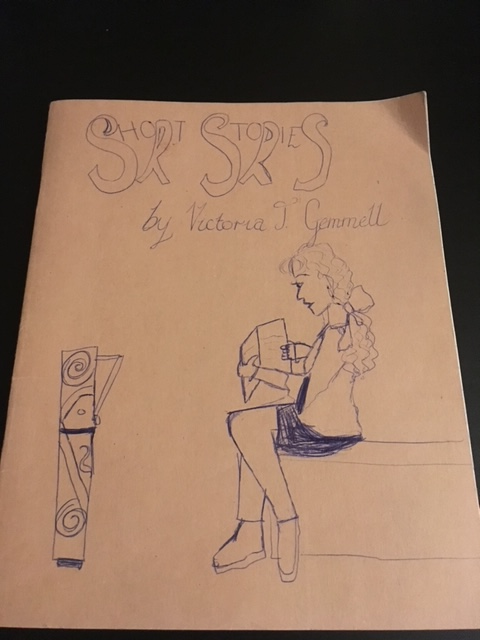
  • When I was in primary seven my older brother indulged me by reading my illustrated Horror novella – Ye olde Castle. Sadly I never kept this notebook, probably too embarrassed by the illustrations of heads rolling down a hill during the unfortunate school trip. My head teacher at the time called me to her office, (not to give me a mental health assessment thankfully.) She encouraged me to keep writing, and showed me a book that a twelve-year-old girl had published (it was about a vegetable family, and I remember being very impressed!). I continued writing many stories during this time – the photo at the top of the blog post is a notebook that did survive. Twenty- odd years later when my first book Follow Me was launched at Waterstones my head teacher attended my launch night and I was able to thank her for her encouragement during my acknowledgements. One of many full circle moments I’ve had in my writing life
  • Another teacher champion: My first year English teacher Mrs Cook told me I was going to be the next Roald Dahl (not quite happened, but this meant a lot at the time as I had grown up loving these books!) and got my class involved in acting out (and I am sure filming!) a play I had written in my own time
  • When I was about twelve or thirteen I finished my first ‘book’ Rhea the Rollerskater and my mum helped me package it and send it off to a publisher. They sent me a very lovely rejection. I love the fact my mum encouraged the process, and the publisher was encouraging, but I think I knew I really needed to give myself a bit more time to develop my craft! And also have some fun along the way. Being too focused on publication can detract from just enjoying the process.
  • When I was seventeen my mum took me along to my first Scottish Association of Writers conference. I was delighted to witness her being presented with a first prize certificate for her short story (from Ian Rankin!) This was a weekend where I first entered a world filled with experienced authors/writers and attended workshops which taught me lots about the craft of writing and storytelling. Twenty years later I was invited to be an adjudicator at the conference. Another full circle moment in my writing life!
  • In my twenties I started getting serious about sending work out and during my early thirties in particular I was on a mission to get my work in print. I felt at this point I had developed my craft enough to write an acceptable short story that could maybe see print. I’ll do a separate post on early submissions/rejections/acceptances and how to approach this
  • Around this time I kept attending the Scottish Association of Writers, as well as attending a brilliant writing festival (that an author at SAW suggested I go to) in York. Sadly this festival no longer runs but I’ve put alternative suggestions in the links below. It was here I met face-to-face with agents for the first time to pitch my novel. What this taught me is a website can tell you only so much about an agent. Meeting them in person allowed me to see how we ‘clicked’ as well as showing me how one totally understood my story, whereas the other did not!
  • Writing friendships ~ I met some of my best friends through writing groups and at a writing networking group. Finding people who are on the same wavelength and who understand the pain and enjoyment writing can bring, as well as being a safe space to share work and your highs and lows, has been such an important part of ‘keeping going’.
  • When my debut YA novel came out I was clueless really about how anything worked in terms of how to organise talks, school events and so on. I’ll do other posts about this, but at the time joining the Society of Children’s Book Writers and Illustrators (SCBWI) and attending their conference and speaking to published authors was so helpful. Fellow published authors who invited me to, and suggested me for, small festivals/talks was so amazing and helped me a lot. Librarians were also so supportive. Signing up to the Scottish Book Trust Live Literature database has helped me secure writing talks/workshops throughout the years (and get paid for them!)

As I live in Scotland I’ve included some Scottish/UK focused links below to help you find your tribe. Happy writing!

Find a Writing Group:

These lists can help you get started: https://www.scottishbooktrust.com/writing-and-authors/writing-groups-in-scotland

https://www.scottishassociationofwriters.com/find-a-writing-group/

Use social media to help you find local groups. I found an informal Glasgow Writers meet up group via facebook

Ask your local library and community centres. Paisley central library host a local group.

Attend Conferences/Writing Festivals/Courses

https://www.scottishassociationofwriters.com/saw-conference-2025/

https://www.cymerafestival.co.uk/2024-writers-conference-programme

https://www.writersandartists.co.uk/events-and-courses

Check college websites for leisure writing courses/online writing courses. This is a great way to connect with other writers. West College Scotland started an online creative writing course in November. I’ve also seen authors I know sharing courses they are running via Dundee Lifelong Learning

Attend a Retreat:

A popular one with writer friends: https://www.moniackmhor.org.uk/courses/

One I’ve got my eye on: https://www.acornwritingretreats.com/

Deviate from the plan

I often say I know a book is working when my characters start to take over. This is why I believe you can plan a rough outline and key aspects of the plot, but you have to give your story and characters permission to deviate from the plan. Just like real life, you can try to plan ahead but often external factors will throw your plans into chaos, or often throw up something better/unexpected.

When creating fully formed characters, until you get to know them properly they’re not always going to fit into your plotlines. You’ll often see writers suggesting you construct ‘characters studies/profiles’ in advance – like what’s their favourite band, foods, key moments from their childhood, are they are a morning/afternoon person? Which can all be helpful, but until they turn up on your page and get stuck into the action of your story and start interacting with your other characters none of that is going to tell you much about where they fit in to the bigger picture of your plotlines.

For my first two YA mysteries my characters told me what was going to happen, meaning I had to deviate from my planned endings. Neither of the original endings felt right. They were both written in and left there for quite a while. I couldn’t quite figure out why the endings didn’t sit well with me until I asked myself ‘but would that character actually do that?’ And then I realised I hadn’t stayed true to them and as soon as I understood this and let go of my own pre-conceived ideas, and really listened to my subconscious, it was obvious they’d already laid out all of the clues for me. Yes, we writers really do have voices talking to us in our heads. An acceptable kind of madness, in this mad world of novel construction.

During the planning stages for Young Blood I always knew I would have two main teen protagonists, Ana and Hope. I wanted to have two contrasting personalities and two contrasting situations. Ana and Hope’s narratives run through alternate chapters. 16 year old Ana is part of a tight-knit family and hasn’t really faced many challenges in life, which gives her a bit of a self-absorbed naivety. The uncertainty of her mum’s potential early-onset dementia diagnosis really shakes up her world. She is also upset when her new friend Hope disappears, and tries to find out what happened to her.

When I first started to plan the story I always thought Ana would dominate as her determination to find out what happened to Hope is a key driver of the plot. But then when my character Hope started to take shape I think she took over a bit!

15 year old Hope’s world was torn apart when she lost her mum three years previously and she finds herself in the care system. Her experiences have been lonely and unsettling and Hope welcomes Ana’s friendship until she’s taken from school one day and finds herself in the ‘House.’

I found writing Hope’s character emotional and her strength and fire, along with her vulnerability, was something I tried really hard to capture throughout the book. Her close bond with Seb in the house, and other key characters inside, also helped to flesh out other aspects of her personality and I started to grow very fond of and protective of her. So far she is probably one of my favourite characters I have written.

Throughout the book Hope finds strength from her family’s tarot cards.

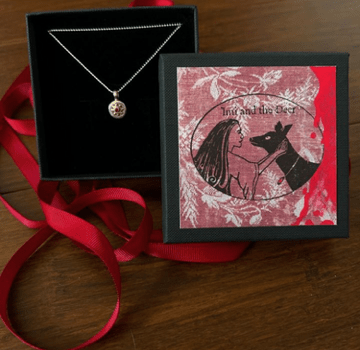
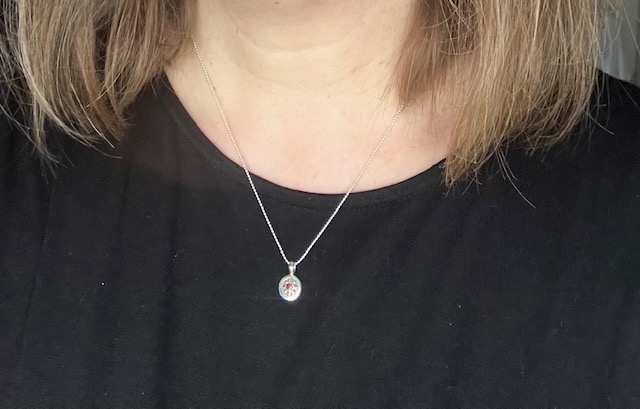
My sister-in-law who makes beautiful handmade silver jewellery (see ImiandtheDeer here) gave me great support with the structural edits of Young Blood (she is a former English teacher!) and half-joked about designing a necklace inspired by Hope as part of a new collection. I was blown away when she gifted me the beautiful ‘Hope’ pendant below at my book launch. The pendant is a one-of-a kind – a ruby set in the middle of a gold sunburst, inspired by the back of Hope’s tarot cards which have a ‘ruby red jewel in the centre of blazing suns burning bright.’

That’s me wearing it on a recent trip to Arran. It’s so lovely to have a piece of jewellery to wear inspired by one of my characters! It makes Hope seem even more real to me.

I’ll leave you with a longer extract from a scene with Hope below. Links to buy Young Blood are here

“A reassuring warmth flowed through my body as I was greeted with the familiar image of a lion with magnificent orange mane, a goddess with flowing fair hair gripping the chain wound around his neck. Strength: You have more strength, power, and courage than you know. I felt the tight knot of anger I’d been carrying around the past few weeks start to unravel as I remembered Mum’s instruction, any time she drew this card for me, tugging on my hair which matched the fire of the lion’s mane. You are the lion AND the goddess. You remember that.
I tucked the card into my schoolbooks for a good luck charm.
Tomorrow I was going to try to be both.”

Re-framing Rejection

Mysticartdesign Image – Pixabay

Recently I re-read Stephen King’s ‘On Writing’ and for me, it still stands out as one of the best books focusing on ‘the craft’. The memoir conversational style of writing throughout creates a very honest and accessible account of King’s journey to becoming a best-selling author, with the technical advice neatly threaded into the narrative in a way that makes you think this guy clearly knows what he’s talking about, as you can read he’s a natural storyteller within the pages of this book.

Things that struck me this time around when I was reading was the fearlessness and tenacity King showed as a young writer when he would study the stories in numerous short story publications, then submit, submit, submit. If he got a rejection (and there were many as he started out), he simply kept going, often re-working and quickly re-submitting elsewhere, all the time consciously developing his craft. He did what we should all do really – don’t dwell on the ‘no’, just strive to get better and to find your story a home where it fits. (Keep reading on and I’ll share a challenge which might help with this)

Ironically the one time King nearly gave up on a piece of writing was with Carrie, his debut novel that launched his career. When he started to write Carrie, it was as a short story, and he felt it just wasn’t working. I love the way King threads in stories about his wife Tabitha, often reminiscing about how she has supported him at key moments throughout his career. Nothing better illustrates this than when Tabitha retrieves the crumpled pages of Carrie out of the bin and tells King to keep going because she wants to see how the story ends. King reflects on what his experience with Carrie taught him and I’ll quote an abridged version here;

Don’t stop a piece of work because it’s hard (emotionally or imaginatively). Keep going even when you don’t feel like it, and ‘sometimes you’re doing good work when it feels like all you’re managing is shoveling shit from a sitting position.’ pg.82

Another section which stood out to me was when King described ‘the first time in (his) life, (when) writing was hard’. This was when he was working as a teacher, and even although he acknowledged the good parts – loving the kids and co-workers – he described ending the week feeling like he had ‘jumper cables clamped to (his) brain.’ (pg. 76) and it was the one time he, ..’came close to despairing about (his) future as a writer.’ I’ve included this in this post as it’s something, even with dropping a day at work, that really resonates with me. With a caseload of close to one hundred young people (doing indepth one to one work), and I’m now in an education setting one day a week, I understand the ‘jumper cables clamped to my brain’ description very well. It takes a lot to decompress, and stay creative.

Staying motivated to write when you have a lot of other things competing with your time is difficult. Especially if you don’t always see much reward.

So, something else I read lately which caught my attention, and actually gave me a spark of motivation, was an article about setting yourself Rejection Goals. You can read ‘Why You should aim to get 100 Rejections a Year’ here (The author of the article Kim Liao actually references King’s On Writing and the way he collected his initial rejections, nailing them to the wall, like a badge of honour).

The idea behind the 100 rejections goal is the more you submit, the more acceptances you are likely to get, and it quietens ‘your fragile ego.’ The perfectionist in me, never mind my fragile creative ego, thinks the psychology of this one is quite clever – if I can trick my brain into thinking my aim is to reach 100 rejections, I’m going to let go of any nagging doubts that I’m not good enough, and to let go of any disappointments of ‘set-backs’ because that simply is no longer the objective of my task.

So if you’re reading this and it seems like a great new challenge to embark upon, why don’t you join me?

We can sail into 2023 with the aim of racking up a lot of ‘nos’, or in the case of modern publishing, a big empty silence of never hearing back …

Good luck!