Interview with a Writer ~ Rosemary Gemmell

This week I’m delighted to welcome my writer Mum, Rosemary Gemmell, technically back to my blog, as Rosemary featured in one of my first ever author interviews, as part of a blog challenge series I did a couple of years ago in November. For this reason I let her choose between mine and my husband’s questions (from last week), to mix it up a bit this time around.

My Mum has been a massive inspiration; penning a range of wonderful books, stories, poetry and articles (as well as academic essays).

It’s thanks to my Mum I felt encouraged from a very young age to develop my writing, and then have the confidence to share it with the world (I don’t think many people are lucky enough to have that type of support from a parent). We often discuss ideas, and what we’re working on. I always trust my Mum to give me insightful and honest feedback, and am very grateful for her technical wizardry and excellent editing!

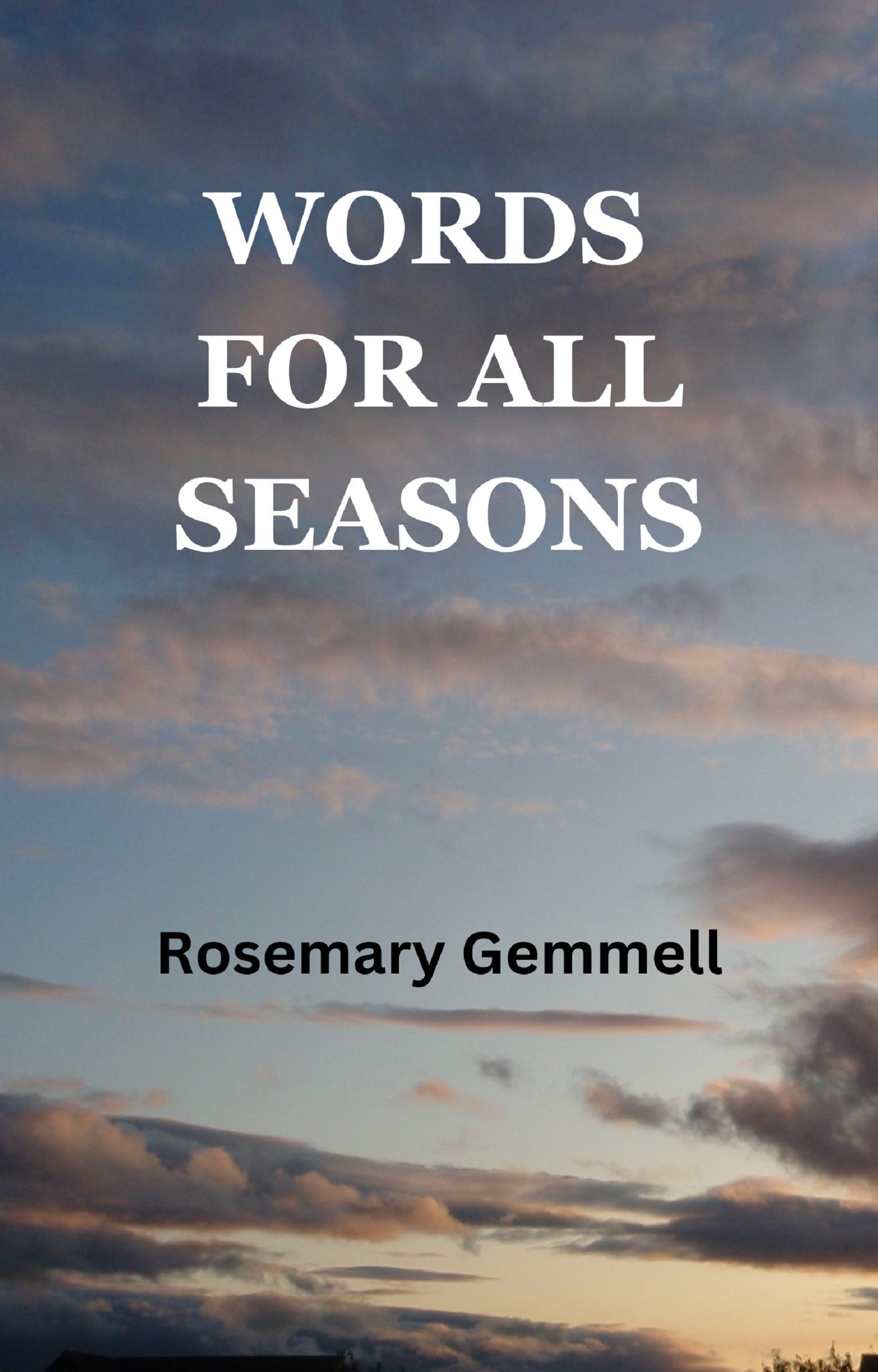
Read on to find out more about a lovely collection of Rosemary’s work titled Words for All Seasons, which would make a perfect Christmas gift!

Author Biography

Rosemary Gemmell is a Scottish novelist and freelance writer based in central Scotland. Rosemary writes contemporary and historical fiction, with occasional short stories, (many of which have won prizes), children’s fiction, articles and poems. Her short stories, articles and poems have been published in UK magazines, the US, and online.

When did you first start writing?

I first wrote creatively at high school when I went through a teenage, romantic phase and adored poetry and literature in general, so I started writing my own poetry. It was many years later before I moved on to articles, then fiction.

What do you write?

I write a little of everything: novels, short stories, articles, poetry, children’s fiction, and even a little bit of drama years ago. I’ve had lots of work published over the years and last year, I decided to put together a celebratory collection of new and previously published stories, articles and poetry along with some of my photographs to illustrate certain pieces. It was partly to highlight the different types of creative writing I enjoy and the book is divided into the four seasons – see below for a review.

Why do you write?

I write to entertain and communicate but also for self-expression and to make sense of the world, especially in non-fiction and poetry.

Share some of your favourite lines from reviews, or comments you have received about your work, which boosted your confidence (tell us what piece of work it relates to)

I’ve been lucky and honoured to have many wonderful reviews for my different books and appreciate each one as they encouraged me to keep writing. However, I don’t even mind a less praiseworthy review as long as I can learn from it.

As a change from my novels, this is a lovely review for my most recent collection, Words for all Seasons, that was published last year (in e-book, paperback and hardback):

What a treat it has been to read Words for All Seasons by Rosemary Gemmell. Her recently published collection of short stories, articles and poems is ideal for dipping into when you have a few moments to spare. The variety ensures there is something to please everyone. Conveniently divided into the four seasons, this is a book you will want to visit – and revisit – no matter what the season.

Any tips for new writers?

Keep reading, as that’s how we best learn what works and what doesn’t, and what type of writer we aspire to be.  And don’t give up at the first few hurdles – we all have to learn as we go, as in any other creative pursuit.

Do you have a regular writing routine, or do you write in frantic bursts?

Neither of the above! I’ve never really had a proper writing routine, much as I’ve often tried. I’m usually more creative in the morning but tend to write when I feel like it, or in short timespans. Sometimes, the less time I have, the better I write – perhaps because I get bored sitting too long at one task.

Where do you write? (A dedicated space, or on-the-go)

My absolute favourite way to write is in cafés or on trains with pen and paper. I’m never distracted by what’s going on around me and can happily sit in my own little bubble of creativity. Beats sitting at home on the computer, though I do have a study where I then type up what I’ve written.

Where do you get your inspiration for your books?

Inspiration for my novels often begins with characters and setting. I’m not so interested in plotting (a weakness) as characters are most important to me as a reader and writer. Once I have an initial idea, I just write and let the characters play as the story develops. I usually have a vague idea of what the story will be about and where it will be set but I like to be surprised by where each book takes me.

What do you think about the concept of AI written books?

We won’t be able to turn the clock back on AI but I hope we never get to the stage of accepting it as a way to write books, especially fiction, although I know it’s already being used. Fortunately, AI is unlikely to ever express our unique human emotions in the same way we can (I hope).

What do you do to get into a ‘creative headspace’?

If writing in my study at home, I love music playing in the background, usually classical, easy listening, or Celtic – sometimes according to what I’m writing.

Where can we find out more about you, and your books?

My website is the best option for a complete overview of all my published books:

https://www.rosemarygemmell.co.uk

Buy Words for All Seasons here

Twitter X @rosemarygemmell (I sometimes take part in #haikusaturday)

And Instagram @rosemarygemmell

Happy 1 year book-versary to Young Blood

This time last year I released my Young Adult crossover thriller Young Blood out into the world so I thought I’d do a post to mark the milestone.

This week I am also running a give-away alongside Ornate Alchemy on Instagram, where you can win one of their beautiful custom-made Bloodstone pendants , and a signed copy of Young Blood. If you live in the UK head over to our Instagram pages to enter: @victoriagemmellauthor @ornatealchemy You have until 5pm Friday!

It always feels strange once a book reaches publication. You spend years perfecting the story, (I’ve not yet mastered a quick turn-around), pouring a lot of heart and soul into the pages, spending hours with the characters in their world, and then suddenly it’s not just in your head anymore; it’s out there on paper for anyone to read. And then you go through a mix of emotions when you realise people are buying the book and actually reading it. What will they think? Will they enjoy it? Will they get past chapter one? Will they like that character as much as you enjoyed writing them? Will they get angry and emotional in the right places? It always delights me (and fills me with relief), when someone tells me they finished my book and loved it. This happened actually at the weekend when a friend’s mother-in-law told me how much she enjoyed Young Blood and was interested enough about the story to ask me about the inspiration behind it.

She said something along the lines of, ‘You write in a lovely way.’ These kinds of comments are so appreciated; I don’t think people realise how much writers need to hear this sometimes. Not to feed our egos, but to motivate us to keep going. I’m at the early stages of writing a new book just now and it always feels like a tricky stage, when nothing is fully formed and you are constantly questioning if this is any good or if it’s the most boring trite that you’ve ever attempted. The characters haven’t all appeared yet, and the ones who have, are still not showing you their true motivations; the setting is still taking shape, the plot has lots of holes and you’re not quite sure what’s next, but you are hoping if you keep writing all will be revealed.

In Scotland, where I live, we’re not very good at celebrating our achievements, often downplaying ourselves in self deprecating ways. Oh you enjoyed my 100,000 word novel, och that was nothing really. Just a little thing I did. Actually it was a big thing, and I locked myself away in a room by myself for hours on end to get the words just right and showed up, and didn’t give up, and saw it all the way through to the final end of being able to hold the finished copy in my hands…

Here’s some extracts from some favourite feedback and reviews I’ve received about Young Blood since it’s release. One of them was written by my Dad; you might think that’s embarrassing and a total faux pas to even mention, a bit like the bad example pitch emails to agents ‘My Mum told me this is the best thing she’s ever read in her life so I know this is going to be a best-seller.’ But actually my Dad hasn’t read much of my work over the years (no slight to him; he doesn’t read much teen fiction, believe it or not! And now he is retired he also has more time on his hands). I think he was maybe a wee bit surprised by how much he actually enjoyed Young Blood, and I was delighted that he did.

The standard of writing is superb, with excellent descriptions of characters and locations without becoming boring. As the mystery progresses you desperately want to find out what is going to happen. This thriller is a compelling read for the YA market and adults alike and I’m not just saying this because I’m Victoria’s Dad! Great Christmas Gift! (hey people get your Christmas shopping in early! – that’s me adding in this comment)

Wow!

Only 19% in and I was on tenterhooks and by half way through I was desperate to know what happened and took it to bed with me. Definitely not conducive for sleep but I just couldn’t put it down.
I loved the twists and turns that had me gasping. Credit for the author. I definitely recommend. A brilliant read!

Thrilling and involving, this is one not to miss.

Young Blood, the latest YA novel by author Victoria Gemmell is not a story for the faint-hearted….These characters are not cardboard cut-outs. They are richly developed, with flaws as well as virtues. Faced with almost impossible choices, a group of teenagers find the courage to challenge the powerful figures behind the conspiracy even though they know that their chances of winning are almost zero.

I was gripped by the story from the start- was a real page turner and was desperate to read on and discover how the plot developed! Can’t wait to read more from this author!

Captivating. This book is made for the big screen.

Great read! Really gripping and loved the character of Hope. Would make a fab film. (Hi, Netflix, are you reading?)

Loved it. Every bit as accomplished as a Good Girl’s Guide to Murder

Have I tempted you yet to take a chance on Young Blood?

If so here’s the links to Amazon to buy: and wider digital channels here: Order into bookshops here and here Abbey Books in Paisley might also still have a copy kicking about

(P.s It’s only £1.99 on kindle just now which is way cheaper than a nice coffee, and it will get your heart racing just as much as caffeine, and the buzz will last longer…)

Deviate from the plan

I often say I know a book is working when my characters start to take over. This is why I believe you can plan a rough outline and key aspects of the plot, but you have to give your story and characters permission to deviate from the plan. Just like real life, you can try to plan ahead but often external factors will throw your plans into chaos, or often throw up something better/unexpected.

When creating fully formed characters, until you get to know them properly they’re not always going to fit into your plotlines. You’ll often see writers suggesting you construct ‘characters studies/profiles’ in advance – like what’s their favourite band, foods, key moments from their childhood, are they are a morning/afternoon person? Which can all be helpful, but until they turn up on your page and get stuck into the action of your story and start interacting with your other characters none of that is going to tell you much about where they fit in to the bigger picture of your plotlines.

For my first two YA mysteries my characters told me what was going to happen, meaning I had to deviate from my planned endings. Neither of the original endings felt right. They were both written in and left there for quite a while. I couldn’t quite figure out why the endings didn’t sit well with me until I asked myself ‘but would that character actually do that?’ And then I realised I hadn’t stayed true to them and as soon as I understood this and let go of my own pre-conceived ideas, and really listened to my subconscious, it was obvious they’d already laid out all of the clues for me. Yes, we writers really do have voices talking to us in our heads. An acceptable kind of madness, in this mad world of novel construction.

During the planning stages for Young Blood I always knew I would have two main teen protagonists, Ana and Hope. I wanted to have two contrasting personalities and two contrasting situations. Ana and Hope’s narratives run through alternate chapters. 16 year old Ana is part of a tight-knit family and hasn’t really faced many challenges in life, which gives her a bit of a self-absorbed naivety. The uncertainty of her mum’s potential early-onset dementia diagnosis really shakes up her world. She is also upset when her new friend Hope disappears, and tries to find out what happened to her.

When I first started to plan the story I always thought Ana would dominate as her determination to find out what happened to Hope is a key driver of the plot. But then when my character Hope started to take shape I think she took over a bit!

15 year old Hope’s world was torn apart when she lost her mum three years previously and she finds herself in the care system. Her experiences have been lonely and unsettling and Hope welcomes Ana’s friendship until she’s taken from school one day and finds herself in the ‘House.’

I found writing Hope’s character emotional and her strength and fire, along with her vulnerability, was something I tried really hard to capture throughout the book. Her close bond with Seb in the house, and other key characters inside, also helped to flesh out other aspects of her personality and I started to grow very fond of and protective of her. So far she is probably one of my favourite characters I have written.

Throughout the book Hope finds strength from her family’s tarot cards.

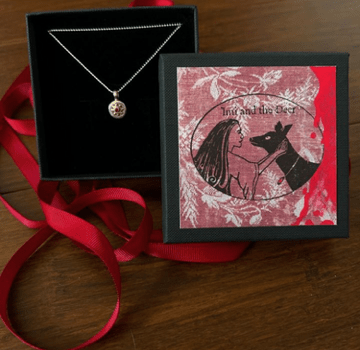
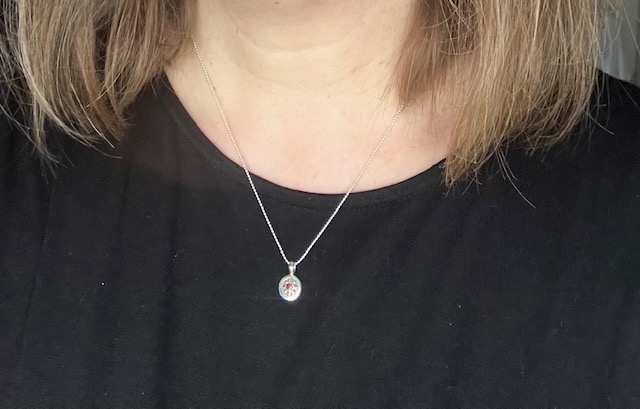
My sister-in-law who makes beautiful handmade silver jewellery (see ImiandtheDeer here) gave me great support with the structural edits of Young Blood (she is a former English teacher!) and half-joked about designing a necklace inspired by Hope as part of a new collection. I was blown away when she gifted me the beautiful ‘Hope’ pendant below at my book launch. The pendant is a one-of-a kind – a ruby set in the middle of a gold sunburst, inspired by the back of Hope’s tarot cards which have a ‘ruby red jewel in the centre of blazing suns burning bright.’

That’s me wearing it on a recent trip to Arran. It’s so lovely to have a piece of jewellery to wear inspired by one of my characters! It makes Hope seem even more real to me.

I’ll leave you with a longer extract from a scene with Hope below. Links to buy Young Blood are here

“A reassuring warmth flowed through my body as I was greeted with the familiar image of a lion with magnificent orange mane, a goddess with flowing fair hair gripping the chain wound around his neck. Strength: You have more strength, power, and courage than you know. I felt the tight knot of anger I’d been carrying around the past few weeks start to unravel as I remembered Mum’s instruction, any time she drew this card for me, tugging on my hair which matched the fire of the lion’s mane. You are the lion AND the goddess. You remember that.
I tucked the card into my schoolbooks for a good luck charm.
Tomorrow I was going to try to be both.”