Interview with a Writer ~ Judith Vallely

Happy New writing year! I’m delighted to kick off 2026 with an interview with writer and journalist, Judith Vallely. After featuring Judith’s writer mum, Myra Duffy, on my blog back in November (see here), it’s a pleasure to now find out more about Judith’s writing career.

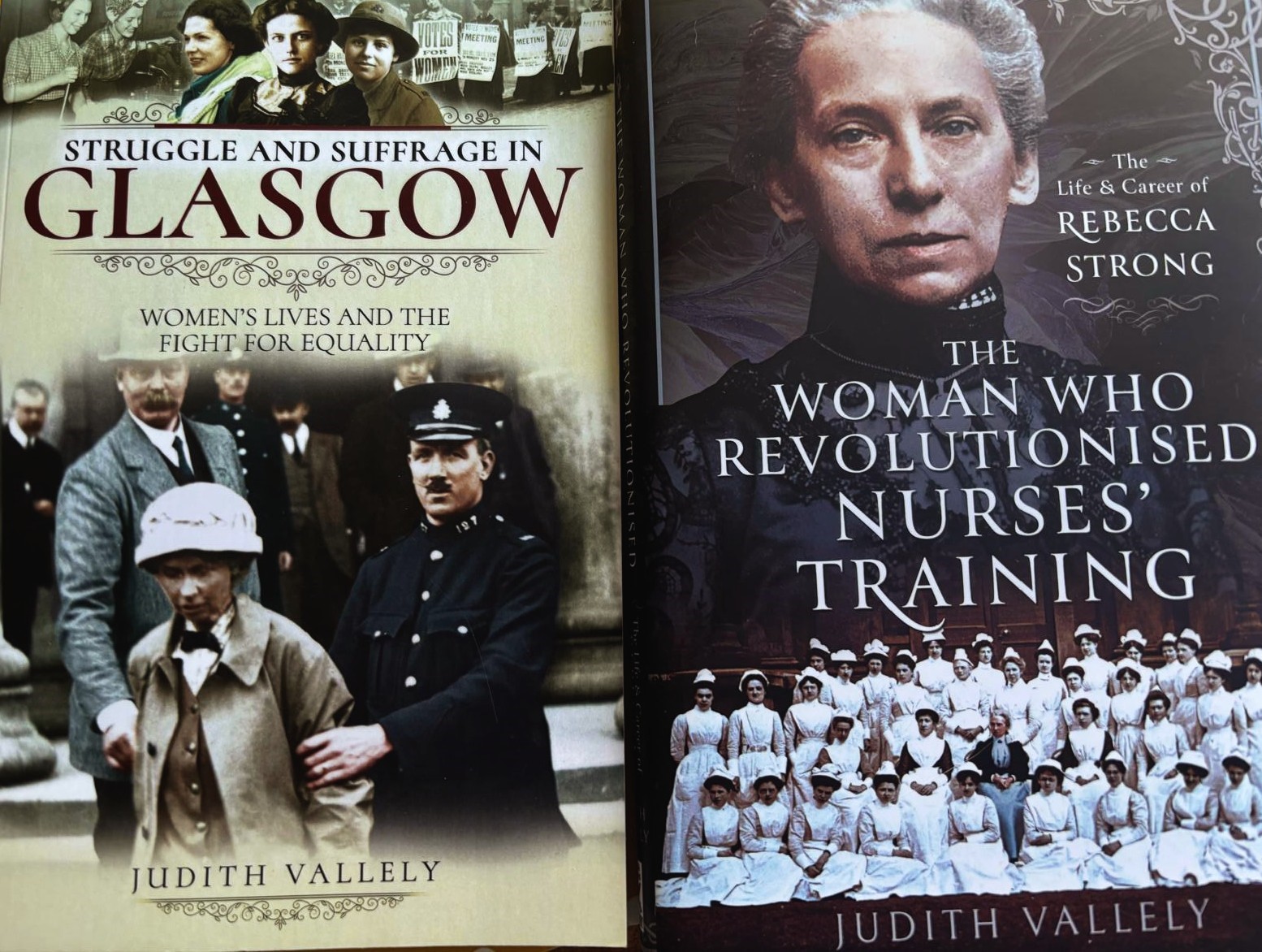
It was interesting to gain insights into Judith’s extensive journalism career, and find out more about how she has managed to balance a busy day job alongside researching and writing fascinating non-fiction books (see photos above of these books, and links below of where to buy).

I have a lot of admiration for writers who manage to multi-task, as it’s something I often struggle with; knowing how to give priority to everything I want to achieve. There’s some great tips here from Judith to keep us all motivated. If you’ve made some writing resolutions of your own this year, I wanted to extract one simple reminder from Judith: ‘If you are struggling to write, just start with a sentence…’ Read on to find out more…

Writer Biography

Judith Vallely is a writer and journalist who lives and works in Glasgow and has an MA in English and Scottish Literature from Edinburgh University, and a postgraduate diploma in newspaper journalism from Napier University, Edinburgh. 

She is the author of Struggle and Suffrage in Glasgow: Women’s Lives and the Fight for Equality and The Woman Who Revolutionised Nurses’ Training: The Life and Career of Rebecca Strong

When did you first start writing?

I’ve always loved reading and writing from a young age – scribbling down various stories. I’m told when I was around five years old I used to sneak out of bed late at night and be discovered looking at books.

What do you write?

I’ve had a 20 plus years career in journalism writing mainly news stories, but also features and travel writing. I’ve also had two non-fiction books published  and am working on improving my fiction writing skills, hopefully with a view to publication one day. 

What was your first published piece of work?

When I was 16 I did a week of work experience at the Evening Times and had a letter published about the dangers of ‘devil dogs’. It was the letter of the day, but I never did get the cash for it!

Why do you write?

Very good question! There’s various answers – I really enjoy discovering and telling stories about people and places. Sometimes I have an idea in my head which I want to get down. Sometimes it’s just because I have a deadline looming! Overall I find writing a really absorbing activity and love words — that thing known as flow, when you get totally immersed.

What, or who, has helped you on your writing journey?

Too many to mention! Journalism has been the biggest part of my writing career and I feel lucky to have started out at a time when it was normal for stories to go through an extensive editing process before being published. In the digital age, it now seems like a long ago luxury to have several editors looking at your work and (usually!) making it better.

And shout-out to my mum (myraduffywriter.com), who has always been very encouraging and a hard act to follow with her many published books! 

Share a writing low with us. What did you learn from this?

I think anyone who has written a book has experienced that moment of thinking it’s just complete rubbish and having the urge to chuck it in the bin forever. However I’ve realised it’s part of the process and that urge must usually be resisted. 

Share a writing high?

My very first story as a journalist was published on the now long defunct Ceefax service. It didn’t have a byline and was just four paragraphs long, as was the format, but it was amazing seeing what I had written out there in the big wide world.

Share some of your favourite lines from reviews, or comments you have received about your work, which boosted your confidence (tell us what piece of work it relates to)

Writing my second book on the life of Rebecca Strong was a real labour of love – I took on the project when I was working freelance but then moved into a very busy full-time job, so it required a lot of dedication (writing and editing by the pool while on holiday in Lanzarote) and the horror of pushing back deadlines (very difficult as a trained journalist) to see it to the end. By the time the book was published I could hardly bear to look at it.

So I was really pleased to get some lovely comments in reviews which made it worthwhile including one which said: “What a great read into the history of what was and how it was shaped into what we now have. Thank you for bringing this information to light, and highlighting the hard work that was put into what we now take for granted”.

Any tips for new writers? 

If you are struggling to write, just start with a sentence – it doesn’t matter how bad or good it is, get something down on the page and then take it from there. There’s nothing worse than a blank page staring at you.

And leave as much time as practical between writing and reviewing your writing – at least overnight. This isn’t always possible, especially in journalism, but I think it is hugely helpful to have fresh eyes on it – and that also should include other people where possible. 

And for all writers; any tips for keeping motivated? And how do you find time to write?

I think the answer ultimately is just to sit down and write – which is easier said than done. An external or self-imposed deadline (such as a competition entry) helps me enormously, as a result of years of journalism.  I am terrible for thinking I’ll write more when…My current ‘when’ is when I have a writing shed but having read Brian Bilston’s very funny ‘Diary of a Somebody’ I realise a/ I am not alone in this and b/ it won’t necessarily help my productivity. 

Do you have a regular writing routine, or do you write in frantic bursts? Where do you write? (A dedicated space, or on-the-go)

I would love to be a writer who gets up at 6am and spends a couple of hours crafting beautiful sentences before the day begins. In reality, I’m not a morning person and can barely string two words together without lots of coffee.  I write wherever and whenever the mood takes me, unless I am working on a book in which case I usually set dedicated time in a little work study at home. 

Any stand-out books you have read recently?

I recently read Elif Shafak’s The Island of Missing Trees for a book group and totally loved it. She writes the beautiful sentences which I aspire to. She probably begins early in the morning, I imagine. 

Where can we find out more about you, and your books?

You can buy Judith’s books here:

Publisher (Pen and Sword), website here

Amazon links: The Woman Who Revolutionised Nurses’ Training: The Life and Career of Rebecca Strong https://amzn.eu/d/h8zibOp

Struggle and Suffrage in Glasgow: Women’s Lives and the Fight for Equality https://amzn.eu/d/6sntOqf

You can find Judith on Twitter X @JudithVallely and Instagram @vallelyjudith

Submission Stories # Part 2 (blog post 10 of series)

This post is about the Journey of Book 2: Promise Me. You can buy my books here.

I’ve tried to strike a balance in this post, of being completely transparent, but not too negative, as ultimately I’m writing these posts to encourage anyone reading to keep going, and to not give up, whichever direction you decide to go with your writing.

When my debut Follow Me was released in 2015 I knew my publisher was interested in reading my next stand-alone, Promise Me.  I was now doing talks and creative workshops in schools and the community, chatting to librarians and slowly building ‘an audience’. Reviews were also starting to come in for Follow Me, and teenagers talked to me about the book at events. (I also got interviewed for Teen Titles magazine at one school).

For the first time in my writing life I was suddenly acutely aware of who might read my new book when it was released, and what their expectations might be. This put a low-level pressure on my creativity; something I had never really experienced before.

I was also trying to juggle the events, (always feeling I was never doing enough compared to other writers I was connected to on social media), whilst working full time. I stupidly went for a promotion at my day job (and got it), all before Promise Me was done and dusted. But it was a time in my life where I felt super-motivated and had more energy (I was younger!!), and the excitement of having a ‘book out’ always spurred me on.

When I had nearly finished my first draft of Promise Me I entered it into the SAW Pitlochry and won second place. The crime writer who adjudicated told me she could imagine her teenage daughter really enjoying having a teen sleuth at the centre of trying to solve the mystery of a crime that had already occurred. I felt this was a good selling point too, and it kept me motivated to get the book finished. I signed the contract for publication in 2017.

Fast-forward two years, copy edits done, release dates promised, then passed, with no response, and so began a repeat cycle. In amongst this a lovely librarian offered to launch Promise Me in her community library in a local area where I had done several events; another librarian wanted to book me for her new festival which would tie in to local schools to promote the release of the book. My publisher knew all of this, and still silence.

I never feel comfortable going into detail about this in a public forum, but needless to say, this was a not a great time for my creative confidence (especially when I genuinely did not know how to explain to the librarians, or to anyone, what was happening, as I had no idea what was happening!).

Every time I heard the question, ‘When’s your next book coming out?’, deep down I felt like a failure.  

I realise now that the people who persistently asked this question hadn’t even read my first book, and had no intention of buying my next one, but the amount of pressure and frustration I felt at the time was immense.

My advice: ignore the external pressures, unless it’s from someone who is involved in bringing your next book to life, and they’re actually nudging out of necessity, or to give you encouragement

The thought of going back out on submission filled me with dread (as the average time of your book seeing the light of day after acceptance, never mind how long it takes to get there, can usually be around 2 years) But I knew I had hit a brick wall with the current situation.

So, at the end of 2019 I took the rights back for Promise Me. I was also in the middle of writing my new YA thriller (Young Blood).

I started to send out Promise Me again to select agents (I was being fussy), but mostly got rejections, or no response. Then I noticed a new publisher was running an open submissions competition for Young Adult novels. I scoured the rules and realised it was open for published writers, as long as you didn’t have an Agent. (Most big competitions like Chicken House and Bath Novel etc. are only open for unpublished writerssee the end of the post for links to these).  

The publisher was professional and dynamic, and making waves, so I excitedly sent off my work.

Fast forward a few months later I received an email to let me know I’d made the long list. The day I moved into my new house in 2020 I received an email from the editor saying I had made the final seven. It was a massive boost. I didn’t win, but the editor had a chat with me and said the book sellers and librarians on the judging panel were very positive about my book. She also offered me some really helpful editorial feedback.

At this point some writers in my network were taking control back, and independently publishing their work. I had watched my Mum do this to a high standard, and she kept saying it was another option I could try.

Not long after this, I entered a call-out for a Zoom pitch event with a big agency. I was selected by the agent to have a chat.

Weirdly she recognised my name as she had been copied in to one of the emails relating to the acquisitions meeting for Follow Me at ‘the big publisher’ I mentioned in my last post. (She was an editor with them at the time).

The agent was really enthusiastic about Promise Me, said she loved the first few chapters and premise, and asked me to send through the full manuscript.

A few months went by with no emails, so I sent a polite ‘nudge’. I received an apology, saying she was behind in reading. I appreciated the update.

Then another six months went by, so I sent another polite email. And never received a response.

To this day, I never did get a response.

I totally understand that agents are busy people. Plenty of agents have ignored me during ‘cold submissions’ which is fine, because most will clearly state on their website, if you have not heard from us in X amount of weeks, we’re not interested.

But when you’ve had a full manuscript request, and a face-to-face chat (it was on Zoom because we were still in semi-lockdown), I think it’s rude to leave someone hanging.

At the time I wish I had used this website called Query Tracker see here You can sign up for free and it provides information on pitching to agents, but also people leave feedback on response times and reply rates from agents they’ve subbed to. The aforementioned agent now runs her own agency, and interestingly lots of people have posted on this site with the exact same experience as me; ghosted after full requests following on from personal contact during pitch events.

During lockdown when life slowed down, it gave me proper time to reflect on what I actually wanted from my writing career. I asked one of my career guidance friends to give me a coaching interview, and this helped me unpick my motivations and priorities.

She asked me an important question: What was stopping me from taking control myself, and independently publishing?

I realised the biggest thing stopping me was fear of perceived external judgement. Who does she think she is….Clearly she’s not good enough if she has to do this herself… We’re not interested in self-published books at this bookshop. But when I unpicked this further I realised none of my worries related to my actual readers. These thoughts related to other writers I knew, random people in my life…mostly ones who had never even read my first book, or cared about it enough to support any attempts at promotion, and gatekeepers (like bookshops *I’ll focus a bit more on the gatekeeper aspect in my next post*).

Returning to the point that the folk who usually ask the most demanding and nosey questions about my writing life (and probably yours), …How many books have you sold? Why’s your next one not out yet?  Are you not quitting your day job yet? Why aren’t you in a window display or the Buy one Get one free in Waterstones? Are you not speaking at X book festival?

..are usually the ones who haven’t even read my work, and are never going to buy my books, even if I get a 5 figure book deal and it’s optioned for film...

In fact those people would probably be the first to ask: How much did you get for your film deal?

I want to point out here that I don’t mind being asked questions about my writing at all, if the intention is good. And I 100% don’t expect everyone in my life to champion my work!  It just made me realise, I shouldn’t care so much about what people think about me and my work, definitely not to the point of stopping me exploring new ways of getting my book out there.

A few months later, I bit the bullet and started the process of Independently publishing Promise Me. It had already gone through many professional copy-edits, I’d received further editorial feedback after the open submissions competition, and I was very fortunate that my Mum is great at editing, and is a genius when it comes to all of the technical support needed to format and publish.

I had already dabbled in releasing a short story collection, and my designer friend Dainty Dora (see site here) aka Rebecca,  supported with a great cover design for this, so I enlisted Rebecca’s support again for the cover of Promise Me.

Promise Me was released into the world in October 2021 and I went with wider distribution, meaning it’s fully available everywhere. I hosted an online launch on release day through Facebook which generated enough sales to put my sales ranking on Amazon alongside big sellers like Holly Jackson. (If you like A Good Girl’s Guide to Murder you might like my books, just sayin’) Those kind of figures are fleeting, but it gave me a huge boost on the day to know people were interested enough to buy my new book.

A screenshot of Promise Me in the Top Ten – glad I captured this moment

A librarian friend also invited me to take part in an online group workshop for a teen writing group, and last Spring I was part of the Paisley book festival schools programme, with Promise Me promoted and bought into libraries. During another school event not long after publication, a highlight was seeing teachers sitting reading my book when I arrived to the class for the session, telling me how much they were enjoying it. Last year an English teacher in a school I’m connected to in my day job said that Promise Me is never on the school library shelves and she often sees pupils reading it. After such a long up-and-down road with this book, every single moment like that means so much to me.

Next time I’ll post a bit more about my experiences of Independent Publishing.

In the meantime, I hope this post hasn’t put you off trying the traditional route, as it’s something I know I will attempt again (due to some of the cons that come with Independent Publishing).

If you’re unpublished and have a novel ready to send I recommend trying one of these big competitions which are closing soon

Chicken House Books Competition – for Children/YA books– closing 2nd June

Bath Novel Award – for both Young Adult and General (adult) fiction Closing 31st May

Bridport Prize – General Novel – Closing 31st May

Keep an eye out on Mslexia Competitions – they have run both General novel and Children’s/YA in the past

Happy Writing!

Interview with a Writer ~Rosemary Gemmell

Today I am using the prompt ‘Interview someone who inspires you’ and I’m excited to have my very own writer Mum, Rosemary Gemmell, on my blog today. There was no better person I could think of to interview for this post as my mum has definitely been my biggest inspiration and support over the years, introducing me first to the world of books, then writing.

A talented and prolific writer since she put words to paper many years ago, here’s a wee insight into Rosemary’s world of writing.

When did you first start writing?

I first wrote poetry when a teenager in high school but I didn’t write anything else creative until after having my two children. Then I started experimenting with all kinds of writing, including academic essays as a mature student.

What do you write?

A little of everything (almost)! I mainly write short stories, articles, poetry, novels and novellas, with occasional children’s fiction.

What was your first published piece of work?

My very first published writing was a letter to a magazine, followed by several more. My first longer piece was an article in a Scottish Women’s Rural magazine. My first published short story was after winning the Short Story Competition at the Scottish Association of Writers conference, adjudicated by the then editor of My Weekly who bought the story for the magazine! My first novel, Dangerous Deceit, was published by a small Canadian company.

Why do you write?

I write partly to communicate and to entertain anyone who likes to read, as well as trying to make sense of all the ideas in my head that clamour for expression. When my imagination is stimulated, I explore it in fiction. But I also write because it’s fun, especially sending work out and waiting to see if anyone wants to buy or read it!

What or who helped you on your writing journey?

The single most useful and helpful decision I made for my writing was to join a local writing group at Erskine, near where I used to live. A wonderful writing tutor, Sheila Lewis (now sadly deceased), came to deliver a six-week session to get us started and ended up staying on as a valued member. She was probably my biggest influence, encouraging me all the way to publication. Lots of other writers have inspired me over the years, especially when attending the SAW conference and entering competitions. Strangely enough, my daughter (thank you, Victoria) also inspires me to be a better writer whenever I read her beautiful and often profound writing.

Share a writing low with us (if you feel comfortable doing so). What did you learn from this?

Although I was lucky to have my first novel published, it went through a few rejections first. The same with short stories – many published but many that just weren’t good enough. Now and then, it was discouraging but it taught me perseverance, to keep going and that the rejections were not personal; it was only a particular piece of writing that didn’t fit that time.

Share a writing high

Winning that short story competition with my first submitted story, then having it published in a well-known magazine, was one of the highlights of my writing career. It was followed by several other competition wins, including one where I was presented with a £1000 prize and a silver cup at a ceremony in Harrogate (Writing Magazine Love Story Winner – those were the days)! But nothing beats that initial confirmation that maybe my writing was good enough. The other main ‘high’ was getting my first full-length novel published as I wasn’t sure I could write longer fiction. Every success is still special.

Share some of your favourite lines from reviews/feedback of your work which boosted your confidence: (tell us what piece of work it’s about)

This was one of the many lovely comments for my first novel, the Regency-era Dangerous Deceit, which really made me want to continue writing books:

I’ve just finished Dangerous Deceit and wanted to let you know how much I loved it. I feel incredibly guilty for racing through the pages when so much hard work went into them, but I couldn’t wait to see what happened. Feel a little sad now it’s over to be honest.”

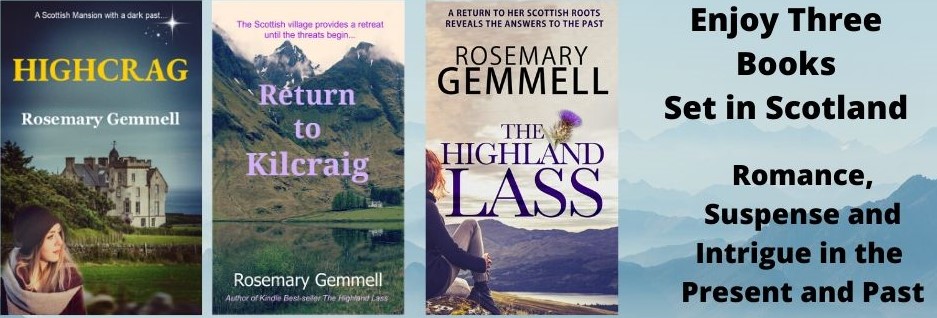
And one from my most recent full-length Gothic suspense novel set in Scotland, HIGHCRAG:

“The characters and the plot blend seamlessly and, like Cate, the reader is unsure who to trust but in the ending all threads of the plot are skilfully brought together in a most satisfying way.”

Any tips for new writers?

First, read as much as you can. If you want to write short stories, read those published. Same with novels – we absorb the ‘how to’ while we read, much more than when reading ‘how to’ books (in my opinion). And read a variety of writing for inspiration.

Second, never give up writing and experimenting with different types and genres until you find the one that is just right for you. If your aim is to be published, keep sending work out – it maybe wasn’t the right piece at the right time to the right person.

And for all writers; any tips for keeping motivated?

Use any short snatches of time to get ideas and sentences down, without the pressure of having to sit and produce a set number of words, as they all add up. A good writing magazine is full of motivation and might help to get you going again. Reading can also help to motivate our own writing, and I find music good for stimulating ideas.

When do you write? Do you have a regular routine, or do you write in frantic bursts?

I’ve never really had a regular writing routine, although I do find my creativity is best in the mornings. I tend to write in short bursts and like going back to a piece to redraft it. I find it too boring to sit at the computer for long so I write shorter items in between novels!

Where do you write? (A dedicated room, or on-the-go)

Although I have a very pleasant room I call my study, with a desktop computer, I write far better with pen and paper when out and about, especially on trains and in cafés. The words seem to flow when writing, or scribbling, longhand and I can easily shut out distractions. I then redraft while typing it up at home. I wrote one of my first novellas almost entirely in longhand while out and about and enjoyed it far more than sitting at the home computer (until redrafting it!).

Any stand-out books you have read this year?

I loved Madeline Miller’s two fictionalized books about Greek mythological figures and their stories, Circe, and then Achilles. They inspired me to finally do an online course to learn Ancient Greek! I also read the wonderful complete Ruth Galloway series by Elly Griffiths, and my favourite LJ Ross DCI Ryan books. There were lots more in paperback and on kindle, of course.

Please share links to your website and where to buy your work so that people can find you

Website: https://www.rosemarygemmell.co.uk

Facebook: https://www.facebook.com/rosemary.gemmell.3/

Twitter: https://twitter.com/RosemaryGemmell

Amazon Author Page: http://www.amazon.co.uk/Rosemary-Gemmell/e/B00U19Z4H4

Thanks to Rosemary for taking the time to answer my questions and for the lovely comment about my writing. I really enjoyed reading about your writing journey.

The Amazon link above will take you to all of Rosemary’s fabulous full length novels, novellas and short story collections. Also, if you are a People’s Friend fan then look out for their 2024 Annual in newsagents now where you will find one of Rosemary’s Christmas short stories

I’m hoping this ‘Interview with…’ spot might be something I continue to feature on my blog for future posts as I think it’s really interesting reading about fellow writers’ (and creatives) journeys and tips!

Re-framing Rejection

Mysticartdesign Image – Pixabay

Recently I re-read Stephen King’s ‘On Writing’ and for me, it still stands out as one of the best books focusing on ‘the craft’. The memoir conversational style of writing throughout creates a very honest and accessible account of King’s journey to becoming a best-selling author, with the technical advice neatly threaded into the narrative in a way that makes you think this guy clearly knows what he’s talking about, as you can read he’s a natural storyteller within the pages of this book.

Things that struck me this time around when I was reading was the fearlessness and tenacity King showed as a young writer when he would study the stories in numerous short story publications, then submit, submit, submit. If he got a rejection (and there were many as he started out), he simply kept going, often re-working and quickly re-submitting elsewhere, all the time consciously developing his craft. He did what we should all do really – don’t dwell on the ‘no’, just strive to get better and to find your story a home where it fits. (Keep reading on and I’ll share a challenge which might help with this)

Ironically the one time King nearly gave up on a piece of writing was with Carrie, his debut novel that launched his career. When he started to write Carrie, it was as a short story, and he felt it just wasn’t working. I love the way King threads in stories about his wife Tabitha, often reminiscing about how she has supported him at key moments throughout his career. Nothing better illustrates this than when Tabitha retrieves the crumpled pages of Carrie out of the bin and tells King to keep going because she wants to see how the story ends. King reflects on what his experience with Carrie taught him and I’ll quote an abridged version here;

Don’t stop a piece of work because it’s hard (emotionally or imaginatively). Keep going even when you don’t feel like it, and ‘sometimes you’re doing good work when it feels like all you’re managing is shoveling shit from a sitting position.’ pg.82

Another section which stood out to me was when King described ‘the first time in (his) life, (when) writing was hard’. This was when he was working as a teacher, and even although he acknowledged the good parts – loving the kids and co-workers – he described ending the week feeling like he had ‘jumper cables clamped to (his) brain.’ (pg. 76) and it was the one time he, ..’came close to despairing about (his) future as a writer.’ I’ve included this in this post as it’s something, even with dropping a day at work, that really resonates with me. With a caseload of close to one hundred young people (doing indepth one to one work), and I’m now in an education setting one day a week, I understand the ‘jumper cables clamped to my brain’ description very well. It takes a lot to decompress, and stay creative.

Staying motivated to write when you have a lot of other things competing with your time is difficult. Especially if you don’t always see much reward.

So, something else I read lately which caught my attention, and actually gave me a spark of motivation, was an article about setting yourself Rejection Goals. You can read ‘Why You should aim to get 100 Rejections a Year’ here (The author of the article Kim Liao actually references King’s On Writing and the way he collected his initial rejections, nailing them to the wall, like a badge of honour).

The idea behind the 100 rejections goal is the more you submit, the more acceptances you are likely to get, and it quietens ‘your fragile ego.’ The perfectionist in me, never mind my fragile creative ego, thinks the psychology of this one is quite clever – if I can trick my brain into thinking my aim is to reach 100 rejections, I’m going to let go of any nagging doubts that I’m not good enough, and to let go of any disappointments of ‘set-backs’ because that simply is no longer the objective of my task.

So if you’re reading this and it seems like a great new challenge to embark upon, why don’t you join me?

We can sail into 2023 with the aim of racking up a lot of ‘nos’, or in the case of modern publishing, a big empty silence of never hearing back …

Good luck!