

Photo by Itai Aarons on Unsplash
So far in this blog series I’ve talked about; perfecting your craft, where to find inspiration and tasks to help unleash your creative magic, the submission process, the importance of connecting with other creatives, and giving yourself space in order to actually create. One question I sometimes ask during creative workshops is What skills do you think a writer should have? And the reason I ask this, is to talk about the less obvious ones that I use all the time (such as communication skills that have nothing to do with the actual writing), but also the ‘softer’ skills that aren’t so obvious, that can help you navigate the highs and lows.
In my day job I talk about skills and strengths all the time when supporting clients to understand how to make good career decisions and set actions to move forward. Recently whilst speaking to a very intelligent client, (this is not breaching any confidentiality as there will no other identifying features other than saying they were very wise!), they said when reflecting on their own life and career paths they have realised what is the most important thing by far over anything (learning, setting goals, having ambition), is fostering resilience. He said you can set goals but inevitably life serves you a lot of curve balls, often forcing you to recalibrate your goals, or abandon them altogether. He said learning to adapt and understanding how to reframe helped him stay resilient and adapt throughout his career.
It was refreshing to hear him say this as it’s a massive part of what I try to help young people I work with in particular understand. I would add self-confidence (and belief), as another very important ingredient to allow you to have the energy to reframe.
If you want to be a writer in the sense of having ambition to be published, (by whatever means), and put your work out into the world to be consumed, two of the most important qualities to develop (alongside your craft!), is resilience and confidence.
In an online writing workshop I delivered back in 2020 (which I had to completely re-write due to the conference being transformed online during a certain pandemic!), I compared the writing journey to a rollercoaster. I am sure many writers have said the same. There are so many highs and lows, often on the same day hand in hand, that it takes a lot of resolve to keep focused on the most important thing:
Your words on the paper; not others
I just came up with that phrase today as a way of reframing my own focus. It seems obvious, when you are writing, to keep focus on your words, but it’s also easy to get pre-occupied by the words of others; reviews, or lack of reviews, rejections, sales reports mocking you with low numbers or zeros…
I’ve written in blog posts before about writers achieving goals, and then feeling they’re still not enough, because we’re always looking ahead to achieve the next one, or make a bigger success of the first one, and all the time dismissing the little wins that a year ago might have felt like a massive win. That can feel like a rollercoaster of reaching the top with one achievement and plummeting if we perceive things don’t go quite as well as planned.
In Aime McNee’s book We Need Your Art, (which I referenced a couple of months ago), in her chapter titled ‘On Failure’, she acknowledges what some of us might label disappointments, but she would rather label failures because she thinks we should embrace failure, as it can make us stronger artists, and encourage us to ‘get better’. I agree with a lot of what she says, as it ties in with one of my first posts on this series where I said I view my writing journey as an apprenticeship, where I am always learning, and as part of that I always want to improve.
She references Carol Dweck’s book Mindset. I’m familiar with Carol Dweck’s work as I attended a full day workshop years ago in my job which focused on her encouragement to foster a ‘Growth Mindset’ and how this should be applied to the school setting, in order to move more towards the attitude that it is okay to fail at things, and actually what is important is the effort you put into trying and learning.
On a recent break a couple of weeks ago I went to see the most spectacular stage show, Moulin Rouge, with my Mum, which was performed at the Edinburgh Playhouse. The whole production was electrifying; the set design, music, singing, dancing and acting. At one point I thought about the hours and sweat and pain that must have gone in to all aspects of the creation of the show, and how gratifying it must have felt for the cast (and hopefully everyone behind the scenes), to see the live reaction from the audience: the full house, the standing ovations, clapping and dancing and signing along at the end, the rapturous applause.
As a writer it is rare you get to have that kind of live reaction with your audience. Unless you do a lot of well-received readings (and I don’t think I’ve ever seen an author during a reading receiving a standing ovation lol). So we’re left to spend hours and hours labouring over our work, releasing it out into the world, and then we have no idea what impact (if any) our work has, unless someone happens to mention to us, or we read a public review. That’s hard! This is something Aimee again mentions in her On Failure chapter, saying ‘Silence is a very specific type of failure.’ (pg 205). When we put our ‘art’ out there and get zero recognition, or engagement.
I see creators on social media talking about this all the time; how they are struggling to get any audience engagement and want to just give up. Just last night I saw a comic strip post by a graphic novelist I follow on Instagram @christinmaricomics, who explores how demoralised she is feeling after the release of her graphic novel (Halfway There) feeling sales are slow, and not getting much recognition (that she perceives anyway) Part of the strip she posted said: ‘…While I don’t think most people make art for wealth or public recognition… those things help us keep making art because it gives our work credit.’ C. Mari I ordered her graphic novel after reading her post, and I’m looking forward to reading it!
When I was sitting in the audience at Moulin Rouge I thought imagine if no one had shown up to see this amazing production, how the creators would have felt, and how sad it would have been for such amazing work never to have reached a wide audience, or been appreciated.
How many creatives must feel this every day: back in the day before streaming the films which ‘released straight to DVD’ instead of the cinema, (but often became massive ‘sleeper hits’ many years later); the bookshop signings where no one shows, or the big retailers choosing to stock already established ‘celebrity’ authors, instead of stocking local authors who are the ones making real connections in local schools but will never reach bigger audiences without commercial outlets promoting them; the musicians who play to empty venues…When Snow Patrol first started to play gigs in Glasgow I was sometimes one of five in the audience at King Tuts and the lead singer Gary would often make a deflated joke about it, but still go on to pour a lot of heart and soul into his performance. Years later they now play to sell-out large stadium gigs so I’m sure he is glad he persisted, and didn’t give up.
According to multiple resources F. Scott Fizgerald’s The Great Gatsby didn’t sell well during his lifetime, and I’m sure we all know the tragic story of Vincent Van Gogh who only sold one painting during his lifetime (The Red Vineyard). How many talented artists never sell one piece of their work, or have it on display?
So many articles or posts about writing focus on surviving the submission process, and the multiple rejections, to get work out there. When I first put ‘my work out there’ I would have really appreciated a post like this, which acknowledges that feeling of rejection you will often experience when the work IS out there, which often hits a lot harder, and that is okay.
Often on social media we present all the highs of our experiences. There are many lows I never talked about when my debut came out: when my books didn’t show up at two big events I was part of (meaning I had no way of selling them to the attending audience); some of the first feedback I ever received was about the typo on the back cover (not my mistake which made it even more deflating!); or that my first ever public published review was quite a dismissive three star one (which wasn’t the issue, I tried to explain to a friend at the time. Three star reviews are part of the deal, and actually could be so much worse, but it was my FIRST one, and the only one showing against my book at the time). Even although I went on to receive many amazing reviews, I never forgot this was my first one, and that the person thought I could basically do a lot better. Agreed, but actually I am so proud of my debut, and there’s a rawness and sense of magic to my writing during that era that I don’t think I’ll ever be able to replicate.
Don’t try to be perfect or live up to others expectations. As a writer it’s your job to provoke many emotions, one of which will be disbelief from others that your work even made its way out into the world in the first place.
At least you tried. And created.
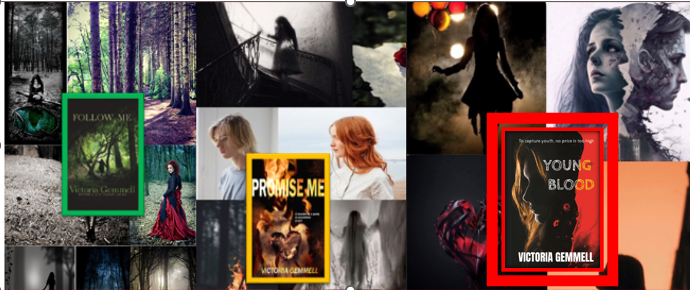
Here’s links to some work I have created






 VICTORIA GEMMELL