Interview a Writer ~ Victoria Gemmell *yes, me


This week I’m doing something a bit different on the blog to fill a gap for a planned post (which will be coming soon…). I thought about just having a week off, but then decided to ask my husband to fire some questions at me last night, with the resulting interview posted below.

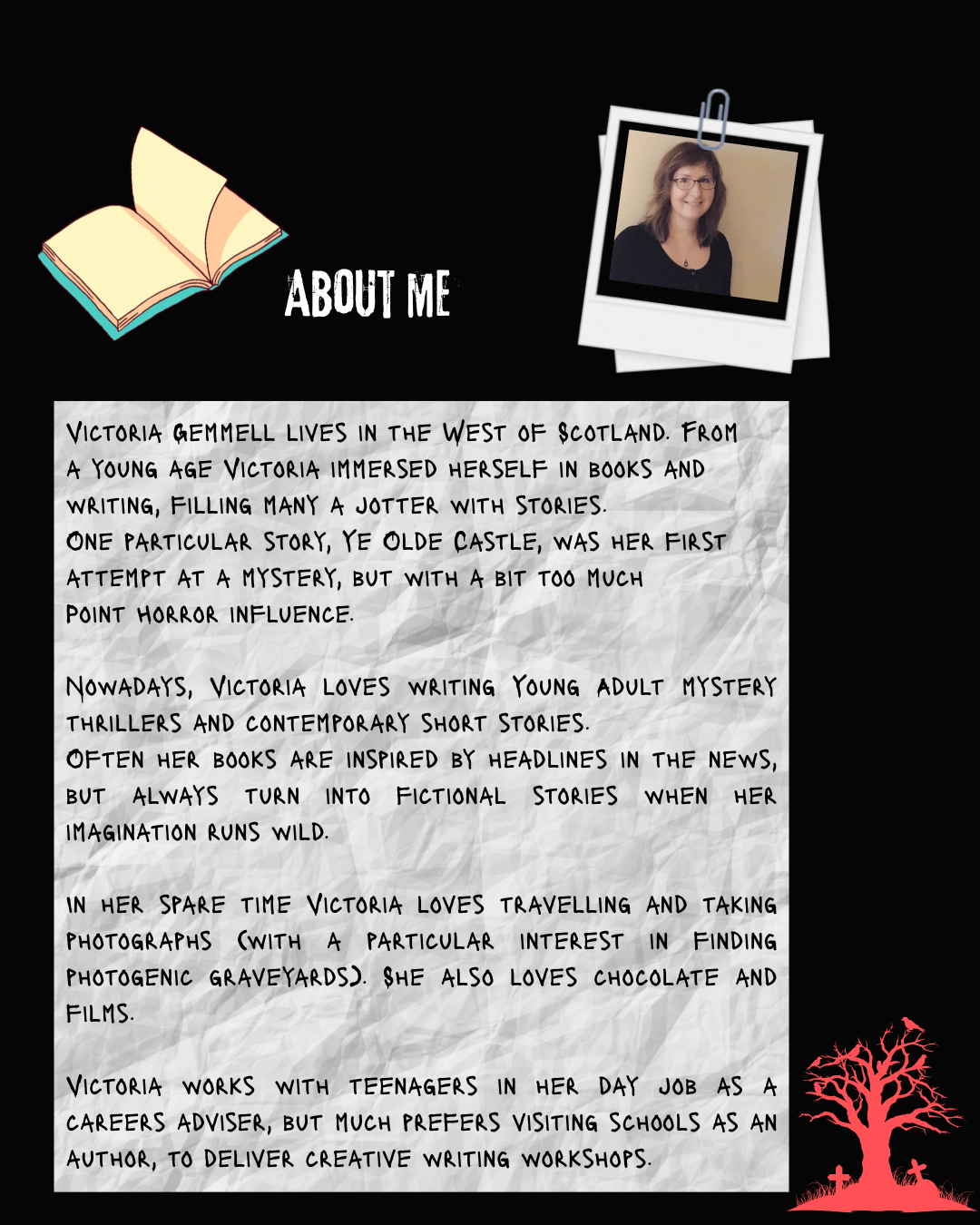
Author Biog (taken from my About Me page) :

Where do you get your inspiration for your books?

Headlines and articles in the news acted as a catalyst for the plots within all three of my YA Mystery/Thrillers. I imagined what would happen if fictional teenagers were placed at the centre of dark situations, (unexplained teen suicides in Follow Me; possible miscarriage of justice in a media obsessed teen murder case in Promise Me; the unveiling of an elite group who kidnap young people from the care system to extract their pure plasma to stay young in Young Blood) My teen protagonists start to uncover hidden truths that adults have been oblivious about, endangering themselves in the process. It’s not until my characters start to form, that the full story will start to unfold.

What do you do to get into a ‘creative headspace’?

Once a book starts to take shape I like to create a playlist for it on Spotify, choosing music which fits the ‘mood’ of the story. To this day there’s one particular Silversun Pickups album that I just need to hit play on and it takes me right back to the emotions I felt when I started to write Follow Me. Finding the right tone and ‘voice’ for a book can be challenging, and music helps me switch off the over-thinking part of my brain. When I’m thinking too much about a story I know it’s not working yet. You need to feel it.

What new book are you working on?

I’m attempting to write a middle-grade magic realism type story. I also have an idea for an adult thriller which might start to take over, so who knows which one I’ll finish first. At this rate it’ll be neither.

What do you think about the concept of AI written books?

Honestly I find it infuriating and worrying. About three years ago we started to talk about AI in work (in my day job as a careers adviser) and the impact it might start to have on certain careers. The topic was brought up on a regional staff day online and a colleague in another region flippantly said, ‘My friend has just written a children’s book with AI and is now selling it on Amazon’. I had to hold myself back as he was actually boasting about it; like it was an amazing achievement. There’s a lot of people out there who I think love the idea of writing a book, and saying they have done so, and love the idea of making money from it (ha, they’ll soon learn). The magic of writing for me is when your brain unlocks almost a super-power you don’t understand yourself; when characters form, ideas and words flow, and it all somehow connects together into a story. Often stories fall flat and don’t work out, and that’s important too. Trying, shaping and learning, and re-writing, and tapping in to your imagination. We’re already being brain-washed by algorithms and dopamine rewards online, which is disrupting our attention spans and the ability to feel ok being bored or at peace…and that’s when we do our best daydreaming and tap into our imagination. (I don’t think it’s a coincidence that I do some of my best thinking these days in the shower or bath!). I don’t want AI to steal our imaginations. It kind of feels like something from the plot of the Never Ending Story when Fantasia is threatened by ‘The Nothing’.

What do you find difficult subjects to tackle?

I shy away from writing anything which involves high-concept epic world-building (think space sci-fi series where characters have unpronounceable names.) I get bored reading this kind of thing, so I know I’d get bored writing it too, and I’d be really bad at it.

What do you enjoy writing about?

I love writing mysteries where I often don’t really know what has happened so I enjoy seeing the plot unfold as my characters develop. That’s the best kind of writing, where you feel like you’re the reader and the plot master rolled into one, and it’s amazing how much you can trust your subconscious to fill in blanks you haven’t even seen. (It’s often why I need to go back to re-write my endings as my characters take over and take me by surprise).

Where can we find your books? (click on highlighted links)

Young Blood: Amazon (paperback and kindle) on worldwide Digital platforms Order into: Waterstones Foyles

Promise Me: Amazon (paperback and kindle) on worldwide Digital platforms Order into: Waterstones Foyles

Follow Me – please contact me direct for a signed copy

Showing up (final post in series- blog post 15)

Back in January I decided to write a series of posts on here which focused on what my writing life has been like over the years. I wanted to share specific aspects that I thought might be helpful for writers just starting out, and also for seasoned writers who maybe just needed a reminder that we all experience very similar highs and lows, and to offer some encouragement to keep going during times you question your sanity, or ask yourself if it’s all worth it.

Over the past couple of months I’ve found it particularly difficult to focus on my writing. I’ve been struggling with tiredness and brain fog, a combination which isn’t great when you’re trying to plot and write a new book. But I’ve been determined to keep getting words down on paper/screen, and keep telling myself the first draft does not need to be perfect.

Embarking on a new book has reminded me of two important things:

It’s important to keep showing up

Each book takes shape in a different way

For my new project I’m trying to get words down not every day, but every week. That’s a win for me just now, and keeps the momentum going. Even although I was knackered yesterday I made myself sit down at my laptop and continue with my next chapter. I’m also doing my usual; scribbling notes in various notebooks and on the notes page on my phone. These pages are filled with plot ideas, characters and locations, that don’t yet have a place on the page, but I know they might eventually fit in somewhere, and it keeps the story ‘alive’ in my head. For me this is all part of the process.

I’d say so far my ‘work in progress’ is a bit messier than usual and as the book will require a lot of detailed description (to world build), I’m finding this is slowing down my natural writing style (which is usually a bit more dialogue heavy). I’m allowing myself to skirt over parts of the descriptions and will go back to fill it in later on. I know I’ll then enjoy it more because by then I’ll be able to see the whole plot laid out in front of me, and see what I need to do to enrich the world and bring it alive (hopefully) for the reader.

I usually like to edit and perfect my story as I go along, so I’m finding it challenging to allow myself to leave messy pages sitting in amongst the more polished ones. I’m used to writing contemporary stories, and this one has a magical element sitting alongside the everyday, so it’s teaching me that it’s okay to deviate from my usual way of working, as its a completely different style of story I am writing.

So as I draw this particular series to an end, if you have been embarking on a new creative project this year, or find yourself at the start of a new writing journey, my parting advice to you is simple:

Keep showing up.

No matter how messy your project might be looking right now, write through it, and come back and tidy up later on.

Watch this space for some insights into other writers’ journeys. I’ve not quite decided what this might look like, but after capturing some of my own experiences over the years, it’s made me curious to hear from other writers, and see what words of wisdom they might have to offer too.

Happy writing!

Here are links to all of the previous posts of the series for easy access:

Starting Out

Learn Your Craft

Learn Your Craft 2

Inspiration is Everywhere Part 1

Inspiration is Everywhere Part 2

Inspiration is Everywhere Part 3

Make Every Word Count

Competitions and Connections

Submission Stories Part 1

Submission Stories Part 2

Don’t wait for the phone to ring

Creative Space

Riding the Rollercoaster

What sells books?

Riding the rollercoaster (blog post 13 of series)

Photo by Itai Aarons on Unsplash

So far in this blog series I’ve talked about; perfecting your craft, where to find inspiration and tasks to help unleash your creative magic, the submission process, the importance of connecting with other creatives, and giving yourself space in order to actually create. One question I sometimes ask during creative workshops is What skills do you think a writer should have? And the reason I ask this, is to talk about the less obvious ones that I use all the time (such as communication skills that have nothing to do with the actual writing), but also the ‘softer’ skills that aren’t so obvious, that can help you navigate the highs and lows.

In my day job I talk about skills and strengths all the time when supporting clients to understand how to make good career decisions and set actions to move forward. Recently whilst speaking to a very intelligent client, (this is not breaching any confidentiality as there will no other identifying features other than saying they were very wise!), they said when reflecting on their own life and career paths they have realised what is the most important thing by far over anything (learning, setting goals, having ambition), is fostering resilience. He said you can set goals but inevitably life serves you a lot of curve balls, often forcing you to recalibrate your goals, or abandon them altogether. He said learning to adapt and understanding how to reframe helped him stay resilient and adapt throughout his career.

It was refreshing to hear him say this as it’s a massive part of what I try to help young people I work with in particular understand. I would add self-confidence (and belief), as another very important ingredient to allow you to have the energy to reframe.

If you want to be a writer in the sense of having ambition to be published, (by whatever means), and put your work out into the world to be consumed, two of the most important qualities to develop (alongside your craft!), is resilience and confidence.

In an online writing workshop I delivered back in 2020 (which I had to completely re-write due to the conference being transformed online during a certain pandemic!), I compared the writing journey to a rollercoaster. I am sure many writers have said the same. There are so many highs and lows, often on the same day hand in hand, that it takes a lot of resolve to keep focused on the most important thing:

Your words on the paper; not others

I just came up with that phrase today as a way of reframing my own focus. It seems obvious, when you are writing, to keep focus on your words, but it’s also easy to get pre-occupied by the words of others; reviews, or lack of reviews, rejections, sales reports mocking you with low numbers or zeros…

I’ve written in blog posts before about writers achieving goals, and then feeling they’re still not enough, because we’re always looking ahead to achieve the next one, or make a bigger success of the first one, and all the time dismissing the little wins that a year ago might have felt like a massive win. That can feel like a rollercoaster of reaching the top with one achievement and plummeting if we perceive things don’t go quite as well as planned.

In Aime McNee’s book We Need Your Art, (which I referenced a couple of months ago), in her chapter titled ‘On Failure’, she acknowledges what some of us might label disappointments, but she would rather label failures because she thinks we should embrace failure, as it can make us stronger artists, and encourage us to ‘get better’. I agree with a lot of what she says, as it ties in with one of my first posts on this series where I said I view my writing journey as an apprenticeship, where I am always learning, and as part of that I always want to improve.

She references Carol Dweck’s book Mindset. I’m familiar with Carol Dweck’s work as I attended a full day workshop years ago in my job which focused on her encouragement to foster a ‘Growth Mindset’ and how this should be applied to the school setting, in order to move more towards the attitude that it is okay to fail at things, and actually what is important is the effort you put into trying and learning.

On a recent break a couple of weeks ago I went to see the most spectacular stage show, Moulin Rouge, with my Mum, which was performed at the Edinburgh Playhouse. The whole production was electrifying; the set design, music, singing, dancing and acting. At one point I thought about the hours and sweat and pain that must have gone in to all aspects of the creation of the show, and how gratifying it must have felt for the cast (and hopefully everyone behind the scenes), to see the live reaction from the audience: the full house, the standing ovations, clapping and dancing and signing along at the end, the rapturous applause.

As a writer it is rare you get to have that kind of live reaction with your audience. Unless you do a lot of well-received readings (and I don’t think I’ve ever seen an author during a reading receiving a standing ovation lol). So we’re left to spend hours and hours labouring over our work, releasing it out into the world, and then we have no idea what impact (if any) our work has, unless someone happens to mention to us, or we read a public review. That’s hard! This is something Aimee again mentions in her On Failure chapter, saying ‘Silence is a very specific type of failure.’ (pg 205). When we put our ‘art’ out there and get zero recognition, or engagement.

I see creators on social media talking about this all the time; how they are struggling to get any audience engagement and want to just give up. Just last night I saw a comic strip post by a graphic novelist I follow on Instagram @christinmaricomics, who explores how demoralised she is feeling after the release of her graphic novel (Halfway There) feeling sales are slow, and not getting much recognition (that she perceives anyway) Part of the strip she posted said: ‘…While I don’t think most people make art for wealth or public recognition… those things help us keep making art because it gives our work credit.’ C. Mari I ordered her graphic novel after reading her post, and I’m looking forward to reading it!

When I was sitting in the audience at Moulin Rouge I thought imagine if no one had shown up to see this amazing production, how the creators would have felt, and how sad it would have been for such amazing work never to have reached a wide audience, or been appreciated.

How many creatives must feel this every day: back in the day before streaming the films which ‘released straight to DVD’ instead of the cinema, (but often became massive ‘sleeper hits’ many years later); the bookshop signings where no one shows, or the big retailers choosing to stock already established ‘celebrity’ authors, instead of stocking local authors who are the ones making real connections in local schools but will never reach bigger audiences without commercial outlets promoting them; the musicians who play to empty venues…When Snow Patrol first started to play gigs in Glasgow I was sometimes one of five in the audience at King Tuts and the lead singer Gary would often make a deflated joke about it, but still go on to pour a lot of heart and soul into his performance. Years later they now play to sell-out large stadium gigs so I’m sure he is glad he persisted, and didn’t give up.

According to multiple resources F. Scott Fizgerald’s The Great Gatsby didn’t sell well during his lifetime, and I’m sure we all know the tragic story of Vincent Van Gogh who only sold one painting during his lifetime (The Red Vineyard). How many talented artists never sell one piece of their work, or have it on display?

So many articles or posts about writing focus on surviving the submission process, and the multiple rejections, to get work out there. When I first put ‘my work out there’ I would have really appreciated a post like this, which acknowledges that feeling of rejection you will often experience when the work IS out there, which often hits a lot harder, and that is okay.

Often on social media we present all the highs of our experiences. There are many lows I never talked about when my debut came out: when my books didn’t show up at two big events I was part of (meaning I had no way of selling them to the attending audience); some of the first feedback I ever received was about the typo on the back cover (not my mistake which made it even more deflating!); or that my first ever public published review was quite a dismissive three star one (which wasn’t the issue, I tried to explain to a friend at the time. Three star reviews are part of the deal, and actually could be so much worse, but it was my FIRST one, and the only one showing against my book at the time). Even although I went on to receive many amazing reviews, I never forgot this was my first one, and that the person thought I could basically do a lot better. Agreed, but actually I am so proud of my debut, and there’s a rawness and sense of magic to my writing during that era that I don’t think I’ll ever be able to replicate.

Don’t try to be perfect or live up to others expectations. As a writer it’s your job to provoke many emotions, one of which will be disbelief from others that your work even made its way out into the world in the first place.

At least you tried. And created.

Here’s links to some work I have created

Submission Stories #Part 1 (blog post 9 of series)

In these posts I’m moving more into a personal ‘behind the scenes look’ at my submission experiences for my three Young Adult books. I’ll do a post for each book. I’m doing these posts because I love to read about other author’s journeys. I find it motivates me and makes me feel less alone in what is quite a mad creative world. Also for all three books I’ve had very different experiences, which resulted in me taking more personal control.

Prior to ‘Book 1’ there were other books, but I refer to them as my practice novels. I completed my first typed ‘novel’ (as opposed to the many, let’s call them ‘novellas’, I had written in jotters) when I was about thirteen, and received my first rejection from a major publisher.  I wrote a magic realism contemporary novel in my early twenties and sent this out to a few publishers and one agent. I randomly met the agent’s assistant at an event and he said he pulled my book out of the slush pile and enjoyed it. (The agent making the decisions, didn’t). Years later I bumped into him at another event and he asked what happened to it. I am sure you are thinking I should have persisted with this one. But I felt I could write better, and by that point I had started to focus more on writing Young Adult, because most of the ideas that were forming in my head seemed to lend themselves better to having teen protagonists. So here’s some highlights of my submission journey with my debut Young Adult novel, which eventually did reach publication back in 2015.

Book 1 – Follow Me

When I first started writing Follow Me something took over. It was the first time a book seemed to take on a life of its own and perhaps because I was living alone at the time, once I had established a basic plot, characters, and written my prologue (which set the tone and gave my protagonist a ‘voice’), every time I sat down I was able to immerse myself fully in the world.

A couple of people who read Follow Me talked about the ‘hypnotic’ characters and feeling like the writing contained some kind of undefinable ‘magic’. I mention this, not to ‘big up’ my book (though I will always have a soft spot for this story), but because it aligns to how I felt early on when ideas and chapters unfolded. I could feel the magic driving this one, and I knew deep down this was going to be ‘the one’; the book I was going to get published, because it was the first time I properly felt like I knew what I was doing structurally, and was excited by the story and characters. Also, something in my mindset had changed. I had started to send out short stories, and was reaching publication, and being placed in competitions. I was starting to believe I could be a ‘serious writer’.

When I had nearly finished my first draft I submitted the book to the TC Farries competition at the Scottish Association of Writer’s conference and won first place.

A well-established children’s author was the adjudicator, and said it contained the ‘magic’ needed to captivate a YA audience. This gave me the confidence to finish it, fine tune my manuscript and start subbing to agents. Colleagues at the time discovered print-outs of my first few chapters and their excitement at reading, and wanting to continue reading (along with my Mum’s encouragement, and another writing friend) all kept me going…

And then when I started to sub to agents I got emails from about three asking very quickly to read the full manuscript. I was on tenterhooks waiting for replies as you can imagine.  But then the rejections started coming in.

Here’s a snapshot of some rejections.

Unfortunately, the premise involving twins is too similar to another title on our list. We wish you the best of luck with placing your work.

Many thanks for sending me your submission, which I read with interest. I’m afraid, however, that I didn’t feel passionately enough about it to offer you representation. You write well, but I’ve just taken on a book which deals with teen suicide so this feels too close to it for me. Our business is subjective by nature and another agent may well feel differently. I wish you the best of luck with that.

I realise now how lucky I was to get some personalised feedback. The landscape of publishing has changed a lot and it can be rare now to get any response.

The most disappointing knock-back was a rejection from an agent I met face to face at a York Writing Festival who was so excited when she read my first three chapters, and was so lovely in person. The type of agent I would have been happy to work with! Interestingly I really didn’t gel with a different agent at my other 1:1 and she suggested quite a graphic, dramatic change to part of my opening which made me feel uncomfortable. This experience showed me the importance of finding the right agent or publisher. Someone you connect with, and who understands your story.

This was the rejection email from the excited agent (I had to wait over 6 months for this, and it felt like a loooong wait):

As you know, I was really excited by your novel when we met in York, and I very much enjoyed reading the complete manuscript. It’s stayed with me and I’ve been ruminating on it since. The premise to the novel is really interesting and I think you write very well for this market. I love sister/twin stories too! I do think there is a lot of potential here, but I’m afraid I don’t think, at the moment, this stands out in what is a crowded market. I’m sorry to disappoint you, but do bear in mind that another agent may feel differently.

I was gutted to get such a positive rejection.

I kept going.

A BIG publisher were doing a call-out for a new teen digital-only imprint, and wanted the full manuscript emailed.

I received this exciting response from one of their editors: Thank you for sending Follow Me to xx for our consideration. I enjoyed reading it and think that your accessible voice matched with the dark and emotional subject matter makes it well suited to the list. …..  (The email then contained some editorial suggestions)…Of course we would discuss all of this later should we decide to acquire Follow Me but I just wanted to check with you before I share the script with the rest of the team whether Follow Me is still available for publication and if you would be open to editorial suggestions such as those I’ve mentioned.

I responded positively. A month later I got this response:

I just wanted to let you know that because it’s been so hectic here, I haven’t taken Follow Me to our acquisitions meeting yet, but I hope to do so next Wednesday and so I should have a decision for your shortly after that.

Then… SILENCE.  Six months later, still nothing.

Around this time I met a different publisher, who ended up taking Follow Me, at a networking event. I nearly didn’t speak to him, because I had already submitted Follow Me to them via their website submission process, but he said he didn’t remember reading it, they’d had server issues, so to email through the whole manuscript.

I emailed the big publishing house to let them know a Scottish publisher had shown interest, and another editor got back to me apologising saying the first editor had gone on maternity leave. She asked me to keep her posted on what happened, and she would read my submission again. Because I was offered print publication (and because the big house had just kept me hanging) I accepted the offer from the Scottish publisher. I had received an email from the Scottish publisher one night saying they had finished reading Follow Me and asked to meet me. Because of the ‘nearly there moments I’d had already’, I still wouldn’t let myself believe it was going to be positive news. But it  was at the face to face meeting I received an offer for publication.

It was fast-moving from there. The meeting took place at the start of April, with a publication date set for October the same year (this is very rare). It was a whirlwind which led to lots of doors opening for me in terms of opportunities to do talks and workshops in schools and in the community. I’ll talk more about those another time. The rollercoaster of ups AND downs continued, something I don’t think many people prepare you for, when you reach the goal of publication.

And sadly, with my second book I found myself back out on submission. I’ll focus on parts of that story in post 2.

I’ll leave you with some things I learned along the way from the first part of this journey:

My tips:

Spend time preparing your submission. Perfect your synopsis and intro email, along with the sample chapters. Follow the submission rules (you’re doing yourself and your book a disservice if you can’t take the time to read these properly and get them right).

If an agent, editor, or publisher takes the time to give you feedback, know that this means they really do see potential in your work and if the feedback contains constructive criticism, take time to reflect and take on board what they say

If you’re pitching to agents and you have the opportunity to pitch to them in person (to allow a face to face conversation) take it! A five minute conversation can tell you so much about the other person, and a two-way conversation allows you to see if they are on the same wavelength about your book

If you’ve spent time perfecting your craft, your book is well-written and enticing, your success now is going to rely a lot on being in the right place at the right time, connecting with the right agent/publisher, and persistence

Related to this: make the most of any writing related networking events you are invited to. Sometimes introductions to the right people means you are noticed and remembered when submitting/pitching

Don’t send your book out to one agent at a time. Any agent who says they want an exclusive read is worth avoiding (unless you’ve made some sort of personal connection with them, but even then I would say no- you’ll find out why in my next blog post). They can take six months, or more, to get back to you (IF AT ALL – the ghosting is real). A lot of very successful authors have had their manuscripts rejected 20 + times, so do your maths on that one. if they were sending them out one at a time, waiting months for responses

Forge friendships with creatives who understand the pain of the ups and downs of this journey. If you detect jealousy and negativity try to spend more time with people who lift you up. Trust me, at ALL times in this weird creative world, even when folk think you are doing well, you need to surround yourself with positive people

And to help us all keep the faith, some famous rejections:

Lisa Genova, Still Alice: about 100 rejections (or non-replies) from agents (info from Lithub.com)

After getting very little positive feedback, Genova opted to self-publish her book. Eventually, it was acquired and re-issued by Gallery Books, an imprint of Simon & Schuster, and proceeded to spend 40 weeks on the New York Times best seller list, and was made into a film.

Audrey Niffenegger, The Time Traveler’s Wife: 25 rejections from agents.

After getting rejected by 25 agents, Niffenegger sent the book directly to a small San Francisco publisher, where an editor discovered and loved it. It became a best seller and was also made into a film.

One of my favourite books of recent years was Lessons in Chemistry. Here’s an interview with author Bonnie Garmus at Maria Shriver’s Sunday Paper (you can read the full interview here https://www.mariashriversundaypaper.com/bonnie-garmus-lessons-in-chemistry/) – Did you indeed receive 98 rejections before Lessons in Chemistry?

“Yes! And they were all from agents. What happened was I had written a novel that was approximately 700 pages…Finally, agent number 98 said that she would read part of it…She wrote back the next day and said, ‘You write well, but you don’t understand this industry…’ The email was pretty nasty, but it was also a very big help. She said, ‘No one’s going to look at a debut author’s 700-page novel—ever. Do yourself a favor and write a novel of appropriate length, and you can send me that when you finish’—which I never did. But that all turned into Lessons in Chemistry. I started completely new. “

Reading these stats makes me realise I’ve never been this persistent. Talent, persistence and resilience. These are the magic ingredients.

Learn your craft #2 (blog post 3 of series)

Photo Shakespeare & Co bookshop, Paris (taken by me)

This post follows on from last week with the focus on perfecting your craft. Last week I shared some hints and tips from writing workshops and talks I’ve attended over the years (read here )

This week I’m going to share some highlights from two of my favourite books about ‘the craft’; Bird by Bird by Ann Lamott and On Writing by Stephen King. The reason I love these books in particular is because they are down-to-earth, honest, funny, include memoir style anecdotes from their own lives (particularly King), and neither writer pretends to know everything about writing. So I trust what they say.

Anyone who pretends to understand everything about how stories or books or poetry work is probably not doing it right, because no matter how much you try to ‘teach’ someone how to put words together, I always think there’s still going to be that indefinable piece of magic (soul, imagination, instinct – call it what you want) that can never be taught and can never truly be explained when analysing a text. But as I said last time, if you want to give your work a good chance of heading in the right direction, you can make life a little bit easier by understanding the foundations which hold it all together.

A lot of what King says in On Writing aligns with other advice I’ve heard in workshops and I recognise a lot of his points when I receive feedback, or when I read others work. I really recommend reading the whole book as it’s a great memoir alongside the hints and tips. I believe there’s various editions of it; the one I have in the house is from the year 2000 (which I think may be my husband’s copy as I used to own an earlier one I am sure). Bear in mind when you get to the part about submitting work that publishing has changed a lot since King started sending books out to publishers/working with agents, so I’m not going to reference any of that. I’ll do a separate post about being out on submission on a future post.

Adverbs and dialogue attribution

I believe the road to hell is paved with adverbs – Stephen King – pg 139

To back up this quote King uses this example; Instead of saying ‘he closes the door firmly’ Just slam the door! Other examples I’m thinking of as I write this would be He ran quickly. You could just have him run.

The over-use of adverbs is one of the biggest mistakes writers probably make. King even admits to still doing it in some of his work, even when he knows it’s a ‘thing’.

He also talks about dialogue attribution On page 140-142 he gives various examples of this:

Jekyll grated. Shayna gasped. Bill jerked out (all after lines of dialogue)

King then goes on to say, ‘writing he said, she said, is divine‘. Just letting the dialogue do the work is something that’s quite hard to do when you are anxious about getting your point across. King acknowledges that mistakes in these areas are exactly because of this, ‘fear that our reader won’t understand us.’

I also think the over-use of adverbs, and adjectives and verbs, (she whispered softly, he shouted loudly), hark back to primary school days when we were learning grammar. I don’t say this to dismiss the importance of learning grammar, (the foundation of any language), but I bet each time you were taught something like an adverb or adjective you then had to insert them into several sentences for homework. And then you got a gold star for creating interesting sentences littered with them. So it’s almost like learning new rules all over again.

Style

King talks about being conscious of using the passive tense (the body was carried from the kitchen being one example he uses of being too passive). He digs deeper into style and how paragraphs are formed. Something I learned when writing my Young Adult mystery thrillers is how shorter sentences and paragraphs can help keep the pace. No one wants to be bogged down by a lengthy description at a crucial tense moment. But then if there’s no variation in your style, it might all feel a bit too frantic, so you need to know when to slow it down too. Feeding in more description is something I’ve become a bit more conscious of, as I know I can sometimes rely too heavily on dialogue and because I’m a very visual writer I have to remember that readers aren’t always going to picture things in quite the same way.

Kings mentions ‘making every word count’ and the importance of editing your work. If you find you often ‘over-write’ a tip from me is to try writing flash fiction. Limiting yourself to 100 words or 500 words is the best exercise in making every word count, and I think it’s a great way to build your confidence as a writer. I’ll do a blog post about writing flash fiction at a later date.

Characters – digging deep

With echoes to last week’s post, both Lamott and and King talk about the importance of characters and Lamott in Bird by Bird talks about ‘writing towards vulnerability’. She really emphasises the point about writing in a ‘directly emotional way.’ This made me think of a quote I see popping up online often ( I’m not sure it can be attributed to anyone in particular): ‘What people remember is not what you’ve done, but how you made them feel’. I think that’s true of books. The ones that stayed with me over the years made me feel something, and that’s because of the characters. They’ve taken me along on their journeys and made me feel all of the emotions.

Lamott says, ‘Plot grows out of character’. King says, ‘I think the best stories always end up being about the people rather than the event, which is to say character-driven.

Obviously you need your characters to do something interesting to be interesting and that’s where the plot comes in. Like we covered in last week’s blog post, your character needs to want something, and then go on some kind of journey. But often you won’t know what they want or what the journey actually looks like, until your characters take shape, and become three-dimensional and believable.

They will probably start to surprise you, just like people in your life often surprise you (in good ways, and bad ways). They might annoy you (especially if they start to take over a bit). In my second YA book, Promise Me, one character started to take over so much that I had to completely change the relationship dynamic I had originally intended. I also had to re-write the ending because the original didn’t ring true to what one of my character’s would have done. A similar thing happened for the ending of Follow Me. This is why I always say you can plot out your novel step by step, but never be scared to deviate from the plan. Humans are unpredictable and if you story becomes unpredictable, that’s when it shows you it’s working, and you get to experience it almost like you are the reader, as well as the writer.

There are loads of books out there about learning your craft. If you’re reading this and thinking of your own favourite, please leave a recommendation in the comments.

I also subscribe to The Writing Magazine which is always packed full of helpful advice and articles. There’s also a great section with call-outs for submissions to competitions, journals, publishers etc.

So now I’ve got you thinking about your craft, what if you’re finding it hard starting on a project.

Next time I’ll be talking about inspiration, and will tell you more about how some of my ideas formed, as well as the importance of allowing yourself to have fun.

Happy writing

Learn your craft (blog post 2 of series)

In my last post I mentioned that a big part of my writing life has consisted of attending writing conferences, groups, talks, and workshops. Over the years I absorbed hints and tips and learned a lot about ‘the rules of writing.’

If you are serious about getting published, or sending your work out into the world, my advice to you is to take your time perfecting your craft.

You don’t always have to know what you’re doing for a good story to take shape as I think natural talent and instinct have a big part to play when letting a story unfold. But it can all get a bit messy if you don’t have a fundamental knowledge of the rules which lie beneath it all; like structure, pacing, dialogue, and character development. If you develop confidence in all of these areas I firmly believe this will help you actually complete that book you maybe keep starting, and never quite finish.

If you want to start submitting stories to journals, magazines, competitions, or books to agents and publishers, then you also have to pay attention to submission formatting rules and perfect your grammar. This is where structured writing groups in particular can be really helpful as there’s usually a good mix of experienced writers in attendance who will happily share their knowledge.

To prepare this post I looked through old USB sticks (tip: if you encrypt your USBs make sure you know where you’re saved the passwords!!), emails and notebooks, looking for advice I had noted down from experienced writers over the years. Here’s some highlights I want to share with you:

Structure and Pace:

Alexandra Sokoloff delivered one of the best workshops I’ve ever attended at the Scottish Association of Writers Conference back in 2015. Before writing novels, she wrote for the screen, and gave us an insight into her ‘Screenwriting Tricks for Authors’ which you can read about fully in her book and you can see a summary outline on her website/blog: Alexandra Sokoloff | Bestselling Author. I loved the way she showed us how our novels could be aligned to a three-act screenplay type structure, highlighting in particular the importance of climaxes throughout to keep readers turning the pages, and ramp up tension/conflict.

A summary of Act 1 (this is on her website so not giving away too much here): Meet the character, show the reader their ordinary world, give hints of their inner/outer desire, give them a problem and a call to adventure, and then add in a climax. She then went on to describe the components of Act 1 and 2.


At the York Writers Festival back in 2013 Julie Cohen delivered a fantastic workshop on the importance of pace:

  • To keep a novel going you need conflict
  • You need to create atmosphere, emotion and show character development
  • Nothing should be wasted; each scene should have two or more purposes
  • Functions (purposes) = Move the Plot forward, Move the Subplot forward
  • Similar to Alexandra’s workshop she mentions Conflict as Hooks – end each scene/chapter with a hook so your reader doesn’t want to put the book down

Emotion:
During workshops on Characters’ emotions- A tip: Sometimes we tend to stick in the safe ‘middle ground’, not going deep enough

Dialogue – use it to reveal more about your character. The way characters talk to one another can tell you a lot about their relationship and how they feel in situations.

Tips on all key things from an agent:
Julia Churchill, one of the biggest UK Children’s Book agents offered Twitter followers the chance to join an hour long zoom workshop (This was back in 2022 when Twitter existed and was a useful platform for writers!) I also heard Julia talk on a panel at the York Writers Festival and she sounded very professional and knowledgeable. She was one of the first agents to request a full read of my YA mystery Follow Me, but decided ultimately it was too dark for her.

  • Characters: A good character needs to come to life.  What do they want and why? And how do they achieve this? Give them a dilemma – a huge stakes thing. What is at stake? Think through the stakes of your story. It needs to have clarity. Character really matters to invest the reader. Think about your favourite character – what makes them special? She gave as an example Charlie, in Charlie and the Chocolate Factory – it was his integrity that mattered.
  • Setting – Think about incredible, vivid, sense of place settings. Setting can add a lot to the story.  
  • Theme – You want to leave the reader with something. A feeling. A message. She gave examples of books which had at the heart ‘being true to oneself’
  • Voice – This plays into a part of you at whatever age the book is targeted at. As a nine-year-old – the sense of magic, warmth, and adventure you want to feel. Teens – takes you back to sense of angst etc. Agents are always looking for authors with a ‘voice’  

Show, Don’t Tell

What does it mean? I talked about this at a workshop with Greenock Writers last year.

If you do too much ‘telling’ in a story it can slow it down, and keep the reader too removed from the action/emotion. ‘Showing’ helps your story come alive. A mix of showing and telling is okay but you need to engage the reader and help them see the story unfold in some way.

Some examples: (From Reedsy and the Writing Pro)

Telling: Michael was afraid of the dark.

Showing: As his mother switched off the light and left the room, Michael tensed. He huddled under the covers, gripped the sheets, and held his breath as the wind brushed past the curtain. 

Telling: When Mary failed her test, she was embarrassed.

Showing: When Mary saw the big red F on her work, her cheeks flushed. She crumpled the test and hid it in her desk, hoping no one noticed.

Telling: The forest is scary.

Showing: The forest is full of staring eyes. The branches look like gnarled hands, reaching out to grab me. Leaves crunch under my feet as I try to find my way home. The air smells like mildew and decay.

My tip:

Read lots, and read widely. You can learn a lot about the craft of writing simply by reading a well-written book or story. Pay attention to the structure, pacing, characters. Why do you love it? Why do you want to keep reading?

Find writers who have broken the rules; books with weird punctuation and strange structures, because once you develop confidence, you can then break the rules and be a bit experimental and creative with your style. When I read Jack Kerouac’s On the Road in my twenties, I found it quite difficult to read but I liked that his stream of consciousness style, with erratic punctuation, was carefree and raw, and it made me realise I was being too ‘self-conscious’ in my writing.

If I am too conscious of trying to write a story, it’s not working. It’s not until I have that feeling of being lost in the story and letting the characters and a subconscious part of my brain take over that I know things are clicking into place.

So follow the rules, learn your craft, but then let go, and just write!

On my next post I’ll share some favourite books which focus on Learning your Craft

#