

Welcome back to Part 2 of my Interview with my writing friend, Layla Blackwell. If you haven’t already, you might want to go and read Part 1 first, where you’ll learn a bit more about Layla’s initial writing journey. You can view that post here.
So let’s return to our chat….
What keeps you motivated?
My coaching work. It’s that wee moment, when you’ve grabbed someone and given them a wee golden nugget, and they’ll go away, and they’ll think about that. I’m now able to use my own experiences; experiences that might have been rubbish for me, and I’m now able to help and support others. They’re getting the benefit of my full life experience. I can reassure people that they will find their own way, in their own time.
What led you into Disability Empowerment Coaching?
You know, it’s really funny, the work I’m doing now is the complete opposite to the work I thought I would do. For the first part of my life, I was running away from essentially being a disabled person because I didn’t like the label.
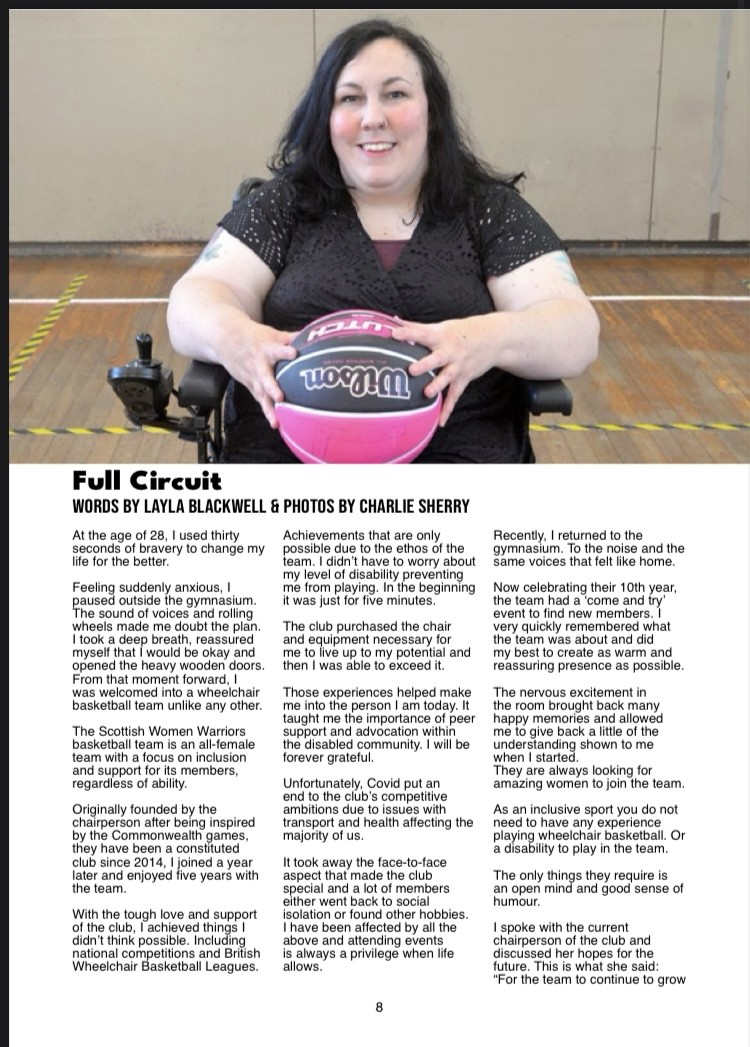
It wasn’t until I started playing basketball, with the Scottish Women Warriors basketball team, when I was 28, my perspective changed. I’ve written an article about that. (You can read this brilliant article Full Circuit here, published in the Clydesider magazine ).
It changed my life in a second, when I went through the doors of the Gym Hall.
Immediately somebody rolled up to me, which is weird in itself, because you’re looking at people at eye level. This woman rolled up to me, and immediately said, What’s wrong with you? I was thinking, Rude! You could at least say hello. But then I remember looking at her face and realising, Oh, she’s using this as a way to connect with me. So I told her I have Cerebral Palsy, And she said, Great, and then rolled away again.
The Basketball Team changed my perspective of disability, and that’s effectively what I’m doing now through my coaching. I’m teaching people with disabilities not to run away from the label, but to change what the label means to them. And that’s what I’ve spent this next, best part of my life doing; just redefining what disability means to me.
So, instead of it being a point of shame, it’s now a point of pride. I can tell people, I’m a Disability Empowerment Coach, that’s what I do. And I mean the middle part (Empowerment), more than I’ve probably ever meant anything in my life.
It was meeting the team that has led here, pushing me past the point I thought I was capable of. I spent about two years trying to say no to everything, and then I got told, ‘Well, that’s not acceptable. And someone’s coming to collect you..’ They wouldn’t let me say no!
How did being part of the Basketball group influence how you approach things today?
Working with the Warriors Basketball Team taught me you can complain, and that’s fine, but if you don’t actually help and make change, then you’re not going to get what you want.
The more I did, the more I also began to understand a couple of things. When it comes to disabilities, mostly people aren’t arrogant, they’re ignorant. I’m actually asking people to understand something that is out with the realm of their understanding.
So that’s the first thing, and the other thing is people are actually afraid of it, because having a disability is the one group you can join at any time. And so that is actually a problem when it comes to trying to make people think about disabilities as they don’t want to think about that scary prospect.
When you join the disability community, there are a lot of angry people that think society should know about disability and they shouldn’t have to advocate for themselves, and it should all just be done. And I think that’s an arrogant point of view, because again, you’re asking people to have an understanding of something they have no concept of. Because if you think about it in terms of freedom, which is the big one for us, right, independence and freedom is the thing that we all want; having autonomy over our own selves firstly, and then independence, and then freedom.
Freedom is a thing we don’t have, (true freedom), and freedom is a thing you don’t even think about. So from that perspective, I don’t know how people expect others to just understand.
If we’re not prepared to educate, then we’re just putting up with arrogance and ignorance. So, I just decided, if people are going to listen, I’m willing to educate them. I thought, You know what? I’m gonna start telling people the way it is.
You can tell people, ‘This is the problem’ but I’ve learned if you don’t actually explain how it affects you, and how to fix it, then they can’t really understand.
When I write articles for the Clydesider, I don’t like to say they’re inspiring, but they definitely have to be positive. When I address a problem, then I will tell you what the effect of that fix would be like. For example, if there were easier ramps on every train, that would mean I could go anywhere, whenever I wanted, which is something I’ve never been able to do. It’s getting better, but it’s still not ideal. People need to understand what the issues are, but also what that means in terms of life. It’s that last bit, that helps people understand more. A lot of disabled representation, depending on what media you access, can be pretty biased.
I feel a responsibility where I have a voice and I have the ability to use it, so that’s kind of why I do what I do. I also think it’s important to do it with a sense of humour. For goodness sake, it needs to have a sense of humour to it, because at the same time, nobody cares, ‘tiny violin playing’ (Layla laughs here), so make it so you’re not just moaning all the time. I’m quite shocked really, the amount of really negative disabled people there are. In a way that gives me great job security (this is some of Layla’s humour coming across here!). It is good to share answers on posts and forums and stuff, about everyday problems, connecting and thinking ‘oh right, that’s normal then’.
I always say to people: You’ve got two choices. Change it, don’t change it. But you know, complaining doesn’t get you anywhere.
Any more advice you would give to people who want to make a change, or influence change, and maybe don’t know where to start?
Big systematic change is really difficult; you’re not going to be able to do that by yourself. But you can make individual change, every day easily, by having a conversation.
And for me goal setting has been important.
If this year has taught me anything, it’s that I don’t know what my own capabilities are. Every time I achieve something, I’ve got to raise the bar as to what I thought I was capable of. If I don’t know what I am capable of, other people certainly don’t.
It sounds kind of silly, but the answer to do things, is always do it!
I love this. I think all writers need to hear this too! Just do it.
Yes, because if you’ve got nothing to work on, no one can help you. The worst that can happen is you can’t work commas and you come back and go, it’s still a bit shit. You’ve got to start somewhere. Everyone starts at the beginning, you can’t start at the finish. And I think that the three seconds of bravery, (in the basketball hall), follows me, as I don’t put pressure on myself anymore to know what I’m doing. I used to think fear was this negative thing, but what I realised is I can be afraid, and still achieve. I just need to acknowledge that, oh actually, this scares me a wee bit. And then I think about why it scares me, but I don’t let it stop me. I just do it anyway. Stop seeing fear as a problem, see it as a challenge. Everyone’s afraid. Once you’ve done it, you’re not afraid of it again.
Wise words from Layla to end on.
Thanks again, Layla, for sharing so many great insights, and trusting me with your words. My blog is just a small attempt to share your words with a wider audience. I am sure anyone reading this will feel inspired and motivated.
Good luck with your writing and coaching!
Again, if you want to connect with Layla, you can find her here:
Website: https://www.laylabecoaching.com/about
Instagram: https://www.instagram.com/laylabecoaching/
Facebook: https://www.facebook.com/laylabecoaching
 VICTORIA GEMMELL