Back in January I decided to write a series of posts on here which focused on what my writing life has been like over the years. I wanted to share specific aspects that I thought might be helpful for writers just starting out, and also for seasoned writers who maybe just needed a reminder that we all experience very similar highs and lows, and to offer some encouragement to keep going during times you question your sanity, or ask yourself if it’s all worth it.
Over the past couple of months I’ve found it particularly difficult to focus on my writing. I’ve been struggling with tiredness and brain fog, a combination which isn’t great when you’re trying to plot and write a new book. But I’ve been determined to keep getting words down on paper/screen, and keep telling myself the first draft does not need to be perfect.
Embarking on a new book has reminded me of two important things:
It’s important to keep showing up
Each book takes shape in a different way
For my new project I’m trying to get words down not every day, but every week. That’s a win for me just now, and keeps the momentum going. Even although I was knackered yesterday I made myself sit down at my laptop and continue with my next chapter. I’m also doing my usual; scribbling notes in various notebooks and on the notes page on my phone. These pages are filled with plot ideas, characters and locations, that don’t yet have a place on the page, but I know they might eventually fit in somewhere, and it keeps the story ‘alive’ in my head. For me this is all part of the process.
I’d say so far my ‘work in progress’ is a bit messier than usual and as the book will require a lot of detailed description (to world build), I’m finding this is slowing down my natural writing style (which is usually a bit more dialogue heavy). I’m allowing myself to skirt over parts of the descriptions and will go back to fill it in later on. I know I’ll then enjoy it more because by then I’ll be able to see the whole plot laid out in front of me, and see what I need to do to enrich the world and bring it alive (hopefully) for the reader.
I usually like to edit and perfect my story as I go along, so I’m finding it challenging to allow myself to leave messy pages sitting in amongst the more polished ones. I’m used to writing contemporary stories, and this one has a magical element sitting alongside the everyday, so it’s teaching me that it’s okay to deviate from my usual way of working, as its a completely different style of story I am writing.
So as I draw this particular series to an end, if you have been embarking on a new creative project this year, or find yourself at the start of a new writing journey, my parting advice to you is simple:
Keep showing up.
No matter how messy your project might be looking right now, write through it, and come back and tidy up later on.
Watch this space for some insights into other writers’ journeys. I’ve not quite decided what this might look like, but after capturing some of my own experiences over the years, it’s made me curious to hear from other writers, and see what words of wisdom they might have to offer too.
Happy writing!
Here are links to all of the previous posts of the series for easy access:
In my last post I mentioned that a big part of my writing life has consisted of attending writing conferences, groups, talks, and workshops. Over the years I absorbed hints and tips and learned a lot about ‘the rules of writing.’
If you are serious about getting published, or sending your work out into the world, my advice to you is to take your time perfecting your craft.
You don’t always have to know what you’re doing for a good story to take shape as I think natural talent and instinct have a big part to play when letting a story unfold. But it can all get a bit messy if you don’t have a fundamental knowledge of the rules which lie beneath it all; like structure, pacing, dialogue, and character development. If you develop confidence in all of these areas I firmly believe this will help you actually complete that book you maybe keep starting, and never quite finish.
If you want to start submitting stories to journals, magazines, competitions, or books to agents and publishers, then you also have to pay attention to submission formatting rules and perfect your grammar. This is where structured writing groups in particular can be really helpful as there’s usually a good mix of experienced writers in attendance who will happily share their knowledge.
To prepare this post I looked through old USB sticks (tip: if you encrypt your USBs make sure you know where you’re saved the passwords!!), emails and notebooks, looking for advice I had noted down from experienced writers over the years. Here’s some highlights I want to share with you:
Structure and Pace:
Alexandra Sokoloff delivered one of the best workshops I’ve ever attended at the Scottish Association of Writers Conference back in 2015. Before writing novels, she wrote for the screen, and gave us an insight into her ‘Screenwriting Tricks for Authors’ which you can read about fully in her book and you can see a summary outline on her website/blog: Alexandra Sokoloff | Bestselling Author. I loved the way she showed us how our novels could be aligned to a three-act screenplay type structure, highlighting in particular the importance of climaxes throughout to keep readers turning the pages, and ramp up tension/conflict.
A summary of Act 1 (this is on her website so not giving away too much here): Meet the character, show the reader their ordinary world, give hints of their inner/outer desire, give them a problem and a call to adventure, and then add in a climax. She then went on to describe the components of Act 1 and 2.
At the York Writers Festival back in 2013 Julie Cohen delivered a fantastic workshop on the importance of pace:
To keep a novel going you need conflict
You need to create atmosphere, emotion and show character development
Nothing should be wasted; each scene should have two or more purposes
Functions (purposes) = Move the Plot forward, Move the Subplot forward
Similar to Alexandra’s workshop she mentions Conflict as Hooks – end each scene/chapter with a hook so your reader doesn’t want to put the book down
Emotion: During workshops on Characters’ emotions- A tip: Sometimes we tend to stick in the safe ‘middle ground’, not going deep enough
Dialogue – use it to reveal more about your character. The way characters talk to one another can tell you a lot about their relationship and how they feel in situations.
Tips on all key things from an agent: Julia Churchill, one of the biggest UK Children’s Book agents offered Twitter followers the chance to join an hour long zoom workshop (This was back in 2022 when Twitter existed and was a useful platform for writers!) I also heard Julia talk on a panel at the York Writers Festival and she sounded very professional and knowledgeable. She was one of the first agents to request a full read of my YA mystery Follow Me, but decided ultimately it was too dark for her.
Characters: A good character needs to come to life. What do they want and why? And how do they achieve this? Give them a dilemma – a huge stakes thing. What is at stake? Think through the stakes of your story. It needs to have clarity. Character really matters to invest the reader. Think about your favourite character – what makes them special? She gave as an example Charlie, in Charlie and the Chocolate Factory – it was his integrity that mattered.
Setting – Think about incredible, vivid, sense of place settings. Setting can add a lot to the story.
Theme – You want to leave the reader with something. A feeling. A message. She gave examples of books which had at the heart ‘being true to oneself’
Voice – This plays into a part of you at whatever age the book is targeted at. As a nine-year-old – the sense of magic, warmth, and adventure you want to feel. Teens – takes you back to sense of angst etc. Agents are always looking for authors with a ‘voice’
Show, Don’t Tell
What does it mean? I talked about this at a workshop with Greenock Writers last year.
If you do too much ‘telling’ in a story it can slow it down, and keep the reader too removed from the action/emotion. ‘Showing’ helps your story come alive. A mix of showing and telling is okay but you need to engage the reader and help them see the story unfold in some way.
Some examples: (From Reedsy and the Writing Pro)
Telling:Michael was afraid of the dark.
Showing:As his mother switched off the light and left the room, Michael tensed. He huddled under the covers, gripped the sheets, and held his breath as the wind brushed past the curtain.
Telling: When Mary failed her test, she was embarrassed.
Showing: When Mary saw the big red F on her work, her cheeks flushed. She crumpled the test and hid it in her desk, hoping no one noticed.
Telling: The forest is scary.
Showing: The forest is full of staring eyes. The branches look like gnarled hands, reaching out to grab me. Leaves crunch under my feet as I try to find my way home. The air smells like mildew and decay.
My tip:
Read lots, and read widely. You can learn a lot about the craft of writing simply by reading a well-written book or story. Pay attention to the structure, pacing, characters. Why do you love it? Why do you want to keep reading?
Find writers who have broken the rules; books with weird punctuation and strange structures, because once you develop confidence, you can then break the rules and be a bit experimental and creative with your style. When I read Jack Kerouac’s On the Road in my twenties, I found it quite difficult to read but I liked that his stream of consciousness style, with erratic punctuation, was carefree and raw, and it made me realise I was being too ‘self-conscious’ in my writing.
If I am too conscious of trying to write a story, it’s not working. It’s not until I have that feeling of being lost in the story and letting the characters and a subconscious part of my brain take over that I know things are clicking into place.
So follow the rules, learn your craft, but then let go, and just write!
SAW conference photos
On my next post I’ll share some favourite books which focus on Learning your Craft
Following on from my post last week this is the first of a series of blogs which delve a bit deeper into what the writing life has been like for me over the years. When I say ‘writing life’ it’s important to emphasise you can be living a writing life without sharing your words, or ever reaching publication.
My love for writing started with a love for reading and as a family we made regular visits to our local library, which at the time was in Inverclyde. My house was always bursting with books growing up and this was thanks to my Mum’s enthusiasm and passion for words. I realised some of my early favourites, such as the Nancy Drew series and Point Horror, have shaped a lot of my writing. All three of my Young Adult books (see here), feature teen sleuths who undercover the truth about some dark mysteries taking place in their Scottish villages.
I wanted this post to be a bit of an overview of what has been important to me over the years. Finding champions (people who encourage, and don’t dismiss your ideas and dreams), and attending writing focused groups/workshops/conferences to learn my craft, have been so important.
Through both, I’ve been supported to bring my stories to life, and found like-minded people to advise and steer me on my way. Being connected to others writers/creatives has kept me motivated and enthusiastic during times I have asked myself why do I devote so much time to this? What’s the point?
For me, writing truly feels like it is in my blood. Even if I take a break from time to time, (or nearly ‘give up’), something always calls from deep down inside me that makes me sit back down at my laptop or notebook (or notes page on a phone!) to shape words into some form of storytelling.
Here’s some key highlights along the way: See links at the bottom of the blog post to help you find groups/courses
My Mum has always been an important champion, always encouraging me to keep writing, and submit my work. When I was eleven my Mum took me along to a new writing group she was attending (Erskine Writers).This introduced me to a magical world of writers, and I realised people actually did this writing thing as a job, or at least submitted stories to magazines/competitions and books to actual publishers…and got their work in print. Over the years Erskine Writers has played a massive part in my development as a writer. It’s where I won my first writing competition and started to read out my work aloud to strangers for the first time, and get critiques from people other than my mum. It helped me develop confidence and taught me the importance of listening to feedback to improve my craft
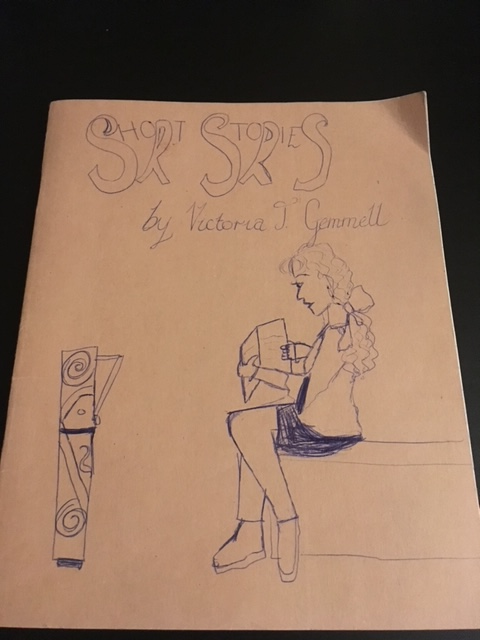
When I was in primary seven my older brother indulged me by reading my illustrated Horror novella – Ye olde Castle. Sadly I never kept this notebook, probably too embarrassed by the illustrations of heads rolling down a hill during the unfortunate school trip. My head teacher at the time called me to her office, (not to give me a mental health assessment thankfully.) She encouraged me to keep writing, and showed me a book that a twelve-year-old girl had published (it was about a vegetable family, and I remember being very impressed!). I continued writing many stories during this time – the photo at the top of the blog post is a notebook that did survive. Twenty- odd years later when my first book Follow Me was launched at Waterstones my head teacher attended my launch night and I was able to thank her for her encouragement during my acknowledgements. One of many full circle moments I’ve had in my writing life
Another teacher champion: My first year English teacher Mrs Cook told me I was going to be the next Roald Dahl (not quite happened, but this meant a lot at the time as I had grown up loving these books!) and got my class involved in acting out (and I am sure filming!) a play I had written in my own time
When I was about twelve or thirteen I finished my first ‘book’ Rhea the Rollerskater and my mum helped me package it and send it off to a publisher. They sent me a very lovely rejection. I love the fact my mum encouraged the process, and the publisher was encouraging, but I think I knew I really needed to give myself a bit more time to develop my craft! And also have some fun along the way. Being too focused on publication can detract from just enjoying the process.
When I was seventeen my mum took me along to my first Scottish Association of Writers conference. I was delighted to witness her being presented with a first prize certificate for her short story (from Ian Rankin!) This was a weekend where I first entered a world filled with experienced authors/writers and attended workshops which taught me lots about the craft of writing and storytelling. Twenty years later I was invited to be an adjudicator at the conference. Another full circle moment in my writing life!
In my twenties I started getting serious about sending work out and during my early thirties in particular I was on a mission to get my work in print. I felt at this point I had developed my craft enough to write an acceptable short story that could maybe see print. I’ll do a separate post on early submissions/rejections/acceptances and how to approach this
Around this time I kept attending the Scottish Association of Writers, as well as attending a brilliant writing festival (that an author at SAW suggested I go to) in York. Sadly this festival no longer runs but I’ve put alternative suggestions in the links below. It was here I met face-to-face with agents for the first time to pitch my novel. What this taught me is a website can tell you only so much about an agent. Meeting them in person allowed me to see how we ‘clicked’ as well as showing me how one totally understood my story, whereas the other did not!
Writing friendships ~ I met some of my best friends through writing groups and at a writing networking group. Finding people who are on the same wavelength and who understand the pain and enjoyment writing can bring, as well as being a safe space to share work and your highs and lows, has been such an important part of ‘keeping going’.
When my debut YA novel came out I was clueless really about how anything worked in terms of how to organise talks, school events and so on. I’ll do other posts about this, but at the time joining the Society of Children’s Book Writers and Illustrators (SCBWI) and attending their conference and speaking to published authors was so helpful. Fellow published authors who invited me to, and suggested me for, small festivals/talks was so amazing and helped me a lot. Librarians were also so supportive. Signing up to the Scottish Book Trust Live Literature database has helped me secure writing talks/workshops throughout the years (and get paid for them!)
As I live in Scotland I’ve included some Scottish/UK focused links below to help you find your tribe. Happy writing!
Check college websites for leisure writing courses/online writing courses. This is a great way to connect with other writers. West College Scotland started an online creative writing course in November. I’ve also seen authors I know sharing courses they are running via Dundee Lifelong Learning
I was lucky enough to extend my festive holiday this year and flew off to sunny skies just as my office was re-opening. A dose of sunshine and relaxation was the perfect way to recharge and have space to reflect on my writing and what I want to achieve in 2025.
I often find when I’m away from everyday life the creative and ‘ideas’ side of my brain really wakes up. I even managed to ‘type’ a short story in my phone while I was sitting out on my balcony in the sun. Having space to think properly also allowed me to reflect on how I could use my blog here in a bit more of a consistent and creative way.
A lot of young people (and adults!) I come into contact with who have an interest in writing are yet to find supportive communities, and don’t know where to start when delving into the world of writing.
Often when I do school or community workshops I’m asked questions around the practical side of writing, as well as my own experiences and how I have approached things. I realised there is a lot I could write about on here, starting with where my writing journey began, and all of the different experiences and creative projects/competitions/workshops I have found to be helpful along the way.
I am no expert by any means within the industry, or a big success, but what I’ve had are real experiences – mostly good, sometimes deflating- over a large period of my life, a lot of which I was lucky enough to be introduced to thanks to being immersed in a supportive writing community (which started with a supportive writing Mum).
Over the years I’ve submitted short stories to competitions/journals, and then started to pitch books to a range of agents/publishers, met with them face to face, made it to publication then changed course so had to go back out on submission; had zoom pitches, a chat with an editor when I made the final seven in a big competition. I’ve faced numerous rejections, been ghosted, and most recently delved into independent publishing. I’ve attended writing festivals/workshops/talks/retreats, absorbed advice from top authors, agents, publishers and other writers of all levels of experience.
After my first book was released I started to deliver creative writing workshops and talks in schools, libraries, community venues, small book festivals, rooms to an audience of three… Adjudicated competitions for writing groups, bigger conferences (and even adapted my workshop to an online version during an unexpected lockdown!). I’ve organised in-person and online book launches, written press releases, been interviewed for a magazine and over the phone by a journalist.
I’ve kept my creative momentum going by setting myself numerous silly and engaging creative challenges over the years, which is good to remind myself about, as often when writing starts to feel too serious/stressful it’s good to take some time out to remember how to be creative. I know a massive challenge of any creative is staying motivated.
That was a bit of a brain dump list but introduces some themes I hope to focus on.
I remember reading once that writing should be treated like an apprenticeship; that it’s a journey of learning. I started my ‘apprenticeship’ way back in primary school and I am still very much learning. Every new writing project I start, I want to be better.
This year I hope to start a new type of writing project, and plan to go back out on submission again to try to secure an agent, which I am sure will bring a whole lot of new experiences and learning.
You can get all of my posts into your email inbox if you subscribe (on my homepage).
I plan to give honest insights into the behind the scenes of what a writing life for me has looked like so far (and new experiences going forward), with links to any interesting groups or writing related sites/comps I come across.
The first post will be going live next week.
Wishing you lots of success in your own writing this year, and just a reminder it’s okay not to feel dynamic in January. If you are still Wintering, take that time to relax and recharge!



 VICTORIA GEMMELL