
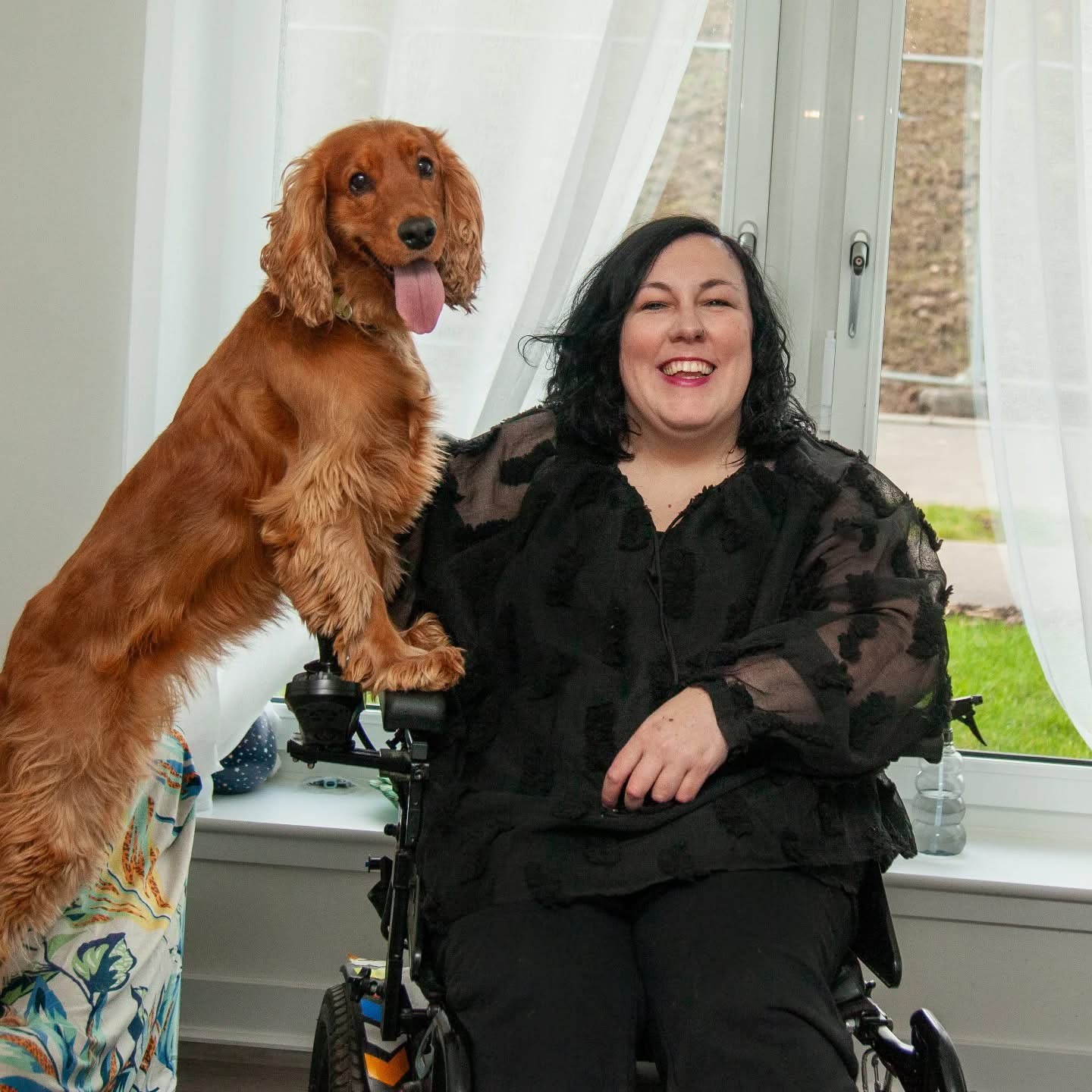
Photography: Caroline Finn

Last week I decided to do something a bit different. I asked my writer friend, Layla Blackwell, if I could interview her for my blog, but this time I wanted to have a more in-depth conversation, so we chatted via Zoom for over an hour. As well as finding out more about Layla’s writing journey, I asked her if she would also tell me about her recent endeavours as a Disability Empowerment Coach, (see Layla’s Coaching website, Layla BE Coaching here). I have to thank Layla for trusting me to transcribe an interview containing over 6,000 words of pure honesty, vulnerability and humour. Not all of our chat made it onto the blog, (we had gossip to catch up on too!), but there was still enough that I wanted to divide this interview into a Part 1 and Part 2, to give Layla’s story the full impact it deserves. So please come back tomorrow evening when Part 2 goes live.
Having this chat, and then re-visiting Layla’s words as I typed them up for the blog, had me feeling so proud, in awe and inspired. I met Layla way back in 2011 (I think!), at a writing networking event I used to regularly attend in Glasgow, called Weegie Wednesday. (I met lots of great writers here, and have fond memories of the years I attended). I love seeing the amazing things Layla has accomplished so far, and I am in no doubt that the best is yet to come for Layla’s writing and coaching/advocacy career. Watch this space.
Biography
Bravery is often defined as ‘courageous behaviour or character.’ For Layla, it’s been a lifelong practice. Born prematurely in November 1987, Layla weighed no more than a bag of sugar. She wasn’t expected to survive. At age two, Layla was diagnosed with cerebral palsy.
Growing up with disabilities meant Layla was surrounded by professionals, and a protective Mum, who all told her what she wanted, thought, and felt. Layla became a people-pleaser, cautious and fearful of a world that wasn’t designed for her. But the moments that changed Layla’s life all came from facing her fears head-on.
From seeing her first piece of creative fiction in print at the age of 21, to joining a women’s wheelchair basketball club at the age of 28, Layla discovered that disability wasn’t just something to ‘overcome’- it could be a point of pride. She found her voice, strength and a community. It showed Layla she was capable of more than she ever believed.
Since then, Layla has been become a published journalist, an advocate, and now a certified ICF life coach.
Why do you write?
I started writing for two reasons. One; talking frustrates me…as much as I do it, and I do a lot of it, talking frustrates me, because it’s difficult to get words right all the time. And I find that a lot of the time, when I have conversations, like when I have this one today, I’ll probably go away and think, you know, I really wanted to say some other stuff, and I forgot to. Or I’ve gone off on a tangent. When you write, you have time to go back and think; this is what I want to put across.
Secondly, from a disability perspective, writing is one of the careers that puts you on an even keel, because you don’t have access issues, and nobody knows you have a disability unless you declare it. It was one of the only careers where I felt everybody was kind of equal to me immediately.
When did you first start writing?
Professionally speaking, I started writing when I was 21, and when I joined Glasgow Writers’ Group. That’s when I learned what professional writing entailed, and then I got published when I was 21.
That leads me on nicely to my next question; what was your first published piece of work?
A short story which appeared in the anthology, A Thousand Cranes: Scottish Writers for Japan (published in 2011 by Cargo Publishing). One of the members of the Glasgow Writers’ Group had links to Japan, and it’s a charity anthology, raising money to support victims of the Haiti tsunami.
I will say my first piece was heavily, heavily edited by editors. Very kindly done, but heavily edited. I don’t actually remember too much about it, because I wrote it one way, and it turned out another. (Layla goes on to talk about how much she learned from initial feedback during this group later on).
Another story almost didn’t get published when I was 21. This was another anthology, with an Australian Press, and was again through a member of the Glasgow Writers’ Group who put me in touch with their publisher and I wrote a couple of pieces for them. After a couple of submissions, they said they were going to publish my work. The editor had given me lots of edits to work on. At first, my work came back absolutely heaving with red pen. And that’s quite difficult when you start off, because it immediately just knocks your confidence, and you think, I might actually just be rubbish at this. It kind of knocked the wind out my sails a wee bit.
I went back and corrected what he asked, but then accidentally sent through the wrong version for my final submission (making it look like I hadn’t fixed any of the issues!). His response to that was he wasn’t prepared to edit it again, but he did, and it went in (there was a lot going on behind the scenes). It taught me the importance of always responding to things professionally.
What did you learn from your experiences connecting with the Writers group (and editors)?
You very quickly learn not to take the red pen personally.
I had been in the Glasgow Writer’s group for a year and nobody would ever give me feedback on what I wrote. And it really annoyed me, because these were quite well known, successful writers, and I really wanted to learn from them. So eventually I was just like, I never get feedback, and I don’t understand why!
And they said, Well, mostly it’s because we don’t want to upset you. Nobody wants to upset you, because we like you.
And I was like, Right, fine, but at the same time I won’t learn, so what are you trying to say?
And basically, it was because the way I was writing was not great. When I was younger in school, people used to take notes for me, scribing for me (due to Layla’s cerebral palsy). So, I actually didn’t really learn sentence structure particularly well.
When I wrote things for the group to read, it was really long sentences and commas were in places they shouldn’t be. Looking back, it must have really frustrated everybody to the point where they could almost not read my work. Instead of saying to me, they were thinking, We don’t want to upset her, and we don’t want to put her off.
I was like, You should have just said to me, and I could have fixed this a year ago!
So then effectively, what I did was I removed all commas from my work for a year ‘till I learned how they worked, and I just kept the sentences really short.
And then I said, Can you at least read this? Is it readable? They said yes!
Then I started to put the occasional comma back in…
It was a turning point, and I then actually started to get feedback on things.
People often think I’m this frail wee thing that they need to be careful of. And I’m like, Just tell me!
What’s really nice now is when I submit work to my editors (at the Clydesider), my editor makes me laugh as she tells me she loves it when I send my work as she doesn’t need to do anything to it. That’s great. I mean, when I think back.
We’ve covered some of this question already in the answers above, but, Who, or what, has helped you on your writing journey?
To be honest, you helped with a bunch of things (thank you Layla). There have been a lot of people that have helped me on my journey, like my friend Fleur, who I first met through the Glasgow Writers’ Group, and then she also came along to Weegie Wednesday, the writing network event (where we met). Fleur gave me feedback on a lot of things. I’ve been really, really lucky.
But I think, to be honest, it’s my own ability to ask for help and the desire to improve and to learn that has helped me a lot to develop my writing.
If I’m writing a particular format, like when I started doing interviews, I didn’t just write it. I went away and I looked and learned: This is how you structure an interview. I paid attention to the structure, before I sent it off (to my editor).
Do you have any stand-out experiences relating to your writing?
The most recent interview I did for the Clydesider, with Sister Rita, talking to her about her work at St Margaret’s Hospice in Clydebank. I was actually front cover for that issue, as I was a featured volunteer in it, and then I had my article with Sister Rita.
I feel like I’ve outdone myself after that. (You can read Layla’s brilliant article ‘A Call to Peace’ here , in the Clydesider magazine).
What advice would you give other writers starting out?
There’s definitely a difference between when you start to write professionally and when you write for fun. And I’m now at the point where people will say to me, you’re a writer, can you look at my work? I now understand how the people in the Glasgow Writers’ group felt when I submitted my work at first.
The first question I always ask is, why are you doing this? Are you doing this for fun? Or are you doing this because you want to be published?
Because if you want to get published, the feedback I would give you is different. If you’re writing for fun, then I’m just going to tell you – the answer is just to write. To be published, you have to look at the format, and different things, that take you from the slush pile to somebody actually taking your work seriously.
But also it just changed my mentality from writing for the sake of writing, to how you write to be published, and actually also the level of detachment you have to have to actually get published. Being really precious about what you’re writing, to a certain extent, is stupid, because it’s going to go through various versions.
What experiences were pivotal for you to expand into different types of writing (moving away from fiction), and also into your coaching work?
When I went through a breakup this year, I decided, right, if you’re going to implode your entire life, then you better make the next bit you do better, like, psychologically. I’d say to myself, Being afraid isn’t necessary anymore, because you faced kind of the worst.
You know, I’ve done a lot this year that I never really thought I was capable of. I’ve done some speaking engagements where I spoke in front of 70 women. (Layla gave me permission to embed an extract of a video she sent me of the intro to the talk she delivered during International Women’s Day. See the bottom of the post for this video).
That experience kind of changed my life. It was weird how it came about. I had been in counselling and wasn’t quite ready to go things alone, so my counsellor introduced me to her daughter, Anne, who is a life coach, who could support me, but also tell me a bit about how to do coaching (something I was becoming interested in).
I think I had been Anne’s client for about a week, and this is the magic and scary thing about life coaching, how this all transpired for me…
Anne said, ‘What goals do you have?’ I told her I wanted to be an advocate for disabled people, but that I’m shit scared of public speaking. It really scares me. I don’t like doing it, but I told her, I need to do it.
Anne came back to me, and said, I’m running an event for International Women’s Day, and I need a speaker.
At first, I was like, Oh, that’s nice.
Then Anne said, That speaker is you.
My initial response was, I beg your pardon?
Anne related it to me saying I wanted to do coaching and explained to me that This was coaching. I set a goal; I achieve the goal. She told me she would help me go through my speech so I felt ready and happy to do it, and then on the day, she was going to be there to support me. She said, So you’re going to be able to achieve that goal. That’s coaching.
I realised this is what I’d been wanting my entire life, is literally somebody to go, You’re afraid of doing that. So, I’ll help you, and go with you. Then it’s less scary.
The thing that really changed my life that day was in the section of my talk, called, Ask a disabled person a potentially embarrassing question. (Layla joked this really needs an acronym.)
I thought I would get silly questions like, ‘Do you sleep with your wheelchair?’ Which I had once and I chose not to answer, because it filled me with rage. So anyway, I expected silly questions, and then a woman stood up and said, ‘I’ve got a son with disabilities, and I’m just wondering if you have any advice as to how to advocate for him properly?’
One of the things I remember in this moment was everybody was kind of in my eye level (as we were sitting facing one another), which was nice, and strange. And I remember looking at her face, and in my brain, I thought ‘Oh!’, because I was just really expecting a silly question.
I admitted this to her, and then said, ‘But you’ve asked me a really important question, so if you don’t mind, I’m going to take a wee minute so I can give you a good answer, rather than just the first answer that pops into my head.’
And so I took a wee minute and I said, ‘Look, the best answer I can give you, and is the same answer I actually told my sister in regards to my niece, because my niece has a disability. The advice I gave to her is essentially to teach your child who they are; backwards, forwards, upside down, in every situation.
‘Teach your son who he is, I said, ‘Because the world is going to spend all of its time telling him who he should be, what he wants, what he needs, what that means, what his life should be like, and if he doesn’t know the answers for himself, he’s not going to be able to live the life that he deserves to live. That’s all my 38 years of experience in every room I have been in.’
I had a wee moment where I was choked up because I realised I’d hopefully just changed that wee boy’s life, even although he’ll never meet me.
I’m sure you would have had the whole room in tears (Layla confirmed she did).
I know you’ll be changing lots of people’s lives with your words, Layla.
Here’s an extract of a video from the introduction of Layla’s inspiring talk from that day:
I’m going to finish Part 1 of Layla’s interview here.
Part 2 will be going live tomorrow evening. Please come back to read more about another pivotal moment in Layla’s life, which she refers to as her ‘three seconds of bravery’, where her perspective about her disability changed, which ultimately led her down new pathways with her writing, and to become a Disability Empowerment Coach.
You can connect with Layla on these platforms:
Website: https://www.laylabecoaching.com/about
Instagram: https://www.instagram.com/laylabecoaching/
Facebook: https://www.facebook.com/laylabecoaching
 VICTORIA GEMMELL
Pingback: Interview with a Writer ~ Layla Blackwell Part 2 | VICTORIA GEMMELL
Wow – what a brilliant and inspiring interview and loved seeing the short video clip and seeing/hearing Layla’s sense of humour coming across!
There’s so much to take from each part of this interview, for anyone embarking on any challenge or new adventure in life, not least anyone living with or confronting a disability. I loved hearing about Layla’s key pivotal moments of facing her fears and forging ahead, and how she’s ultimately come out stronger and learnt so much about herself, as well as now being able to help and coach others. Weegie Wednesday was a lovely event while it lasted and feel lucky to have met such great friends through it ❤
LikeLiked by 1 person
Thanks for reading Rebecca. I totally agree- Layla’s motivating words will resonate for anyone facing challenges, and I loved hearing all about her experiences. So glad I did this interview. It has made me feel inspired!! And grateful to have met great friends at Weegie too 😊
LikeLike
Pingback: Interview with A Writer ~ The Highlights | VICTORIA GEMMELL